Executive Summary
India vs USA hiring is one of the biggest cost-and-talent decisions a growing engineering team faces in 2026, and the honest answer is: it depends on what you’re optimizing for, and the calculus has changed since last year. Three forces are reshaping this India vs USA hiring decision right now:
- The AI hiring split. India’s IT sector cut broad recruitment even as AI-specific hiring rose sharply — companies aren’t hiring less, they’re hiring differently.
- The cost gap remains large but the “why” has shifted. It’s no longer just cheaper labor; India now offers senior, AI-fluent engineering talent at 65–75% lower total cost than equivalent U.S. hires, inside a maturing Global Capability Center (GCC) ecosystem.
- Credentials matter less than proof of work. Employers on both sides of the Pacific are weighting GitHub repositories, deployed projects, and demonstrated AI fluency more heavily than degrees alone.
This India vs USA hiring guide breaks down the real 2026 numbers — salaries, time-to-hire, compliance load, and where each country genuinely wins — so you can make an evidence-based hiring decision instead of a gut-feel one.
The 2026 India vs USA Hiring Market Overview
Global tech hiring in 2026 is not a single story — it’s two stories running in parallel, and that divergence is exactly why India vs USA hiring decisions look different than they did two years ago. In the United States, the U.S. Bureau of Labor Statistics reports that the median annual wage for software developers was $133,080 in May 2024; compensation varies materially by industry, location, seniority, and equity. Demand for experienced, AI-literate engineers remains strong, but headcount growth at large U.S. tech employers is more selective than during the 2021–2022 hiring boom.
In India, the picture is more nuanced. Broad-based IT recruitment has been cooling, but that cooling masks a sharp divergence underneath. According to Naukri’s JobSpeak report, cited by Reuters, AI-related hiring in India’s IT sector rose 16% year-on-year in June 2026, even as overall IT job postings fell 3%. Zoom out across the wider economy and the trend gets stronger: AI and machine-learning roles grew 25% across 14 industries beyond IT, with insurance and consumer goods posting the sharpest gains.
Info Edge CEO Hitesh Oberoi captured the shift succinctly, noting the split “shows where tech companies are still investing,” as AI becomes central to how enterprises operate rather than an experimental side project. Meanwhile, foundit’s Insights Tracker report found India’s hiring activity rose 15% year-on-year in 2025, with nearly 290,000 AI-linked roles posted that year — and AI hiring is projected to grow 32% year-on-year in 2026 to roughly 380,000 roles.
What this means for global employers: the old assumption behind India vs USA hiring — “India equals volume, cheap, generalist hiring” — no longer holds. India’s 2026 talent market is bifurcating into a large pool of generalist IT professionals facing a softer market, and a smaller, fast-growing, well-compensated pool of AI-native specialists that global companies are now competing for directly.
India vs USA Hiring: Salary Analysis for 2026
The core of any India vs USA hiring decision is the numbers, and salary comparisons get muddied by which data source, seniority level, and company type you’re looking at. Here’s a consolidated view using base salary and fully-loaded employer cost, which is the number that actually matters for budgeting. If you want a role-by-role breakdown, Grizmo Labs’ hiring cost calculator does the math for your specific roles.
Base salary by seniority
| Level | United States (base) | India (base, product companies) |
|---|---|---|
| Entry-level software engineer | ~$137,000 | $14,000–$20,000 |
| Mid-level software engineer | ~$138,000–$149,000 | $14,200–$29,600 |
| Senior software engineer | ~$175,000–$198,000+ | $30,000–$60,000 |
Sources: Glassdoor March 2026 data; Kaam.work’s 2026 India-US-UK benchmark study.
Fully-loaded employer cost: the real India vs USA hiring number
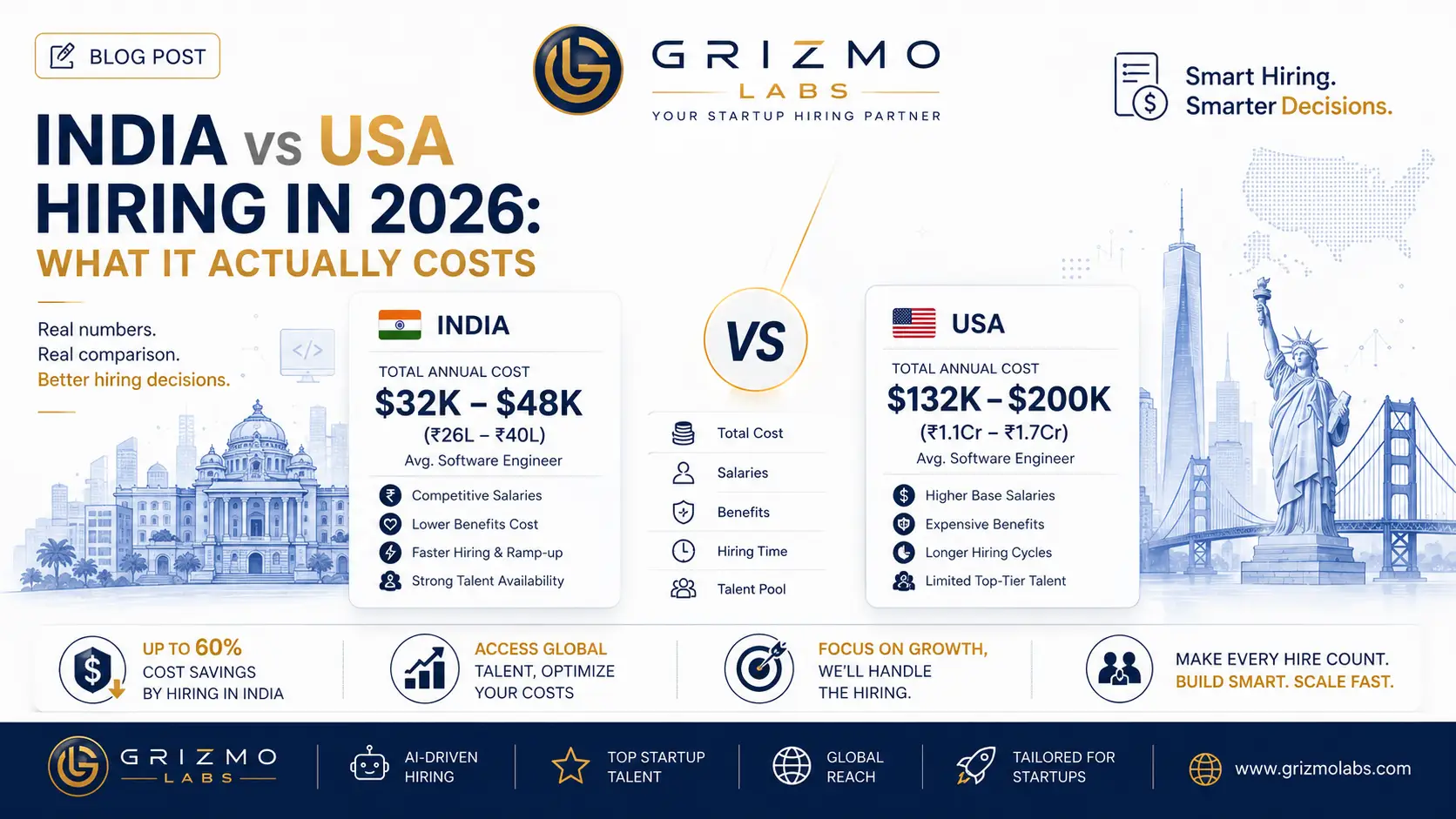
This is where the India vs USA hiring comparison becomes decision-relevant. A senior software engineer hired directly in the U.S. carries far more than base salary once you account for payroll tax, benefits, equipment, and recruiting overhead. Industry benchmarking puts a U.S. senior software engineer’s total employer cost at $200,000–$215,000 a year, while a comparable India-based senior engineer, managed through an employer-of-record or GCC-style model, runs meaningfully lower once statutory contributions are added. In India, total employer cost typically adds 15–25% above gross salary for EPF, ESIC, and gratuity obligations, versus 25–35% in the U.S. for payroll taxes and benefits.
Compiled cost-of-hire research puts the net effect at a 65–75% total cost reduction for a senior engineering hire in India versus a directly-employed U.S. counterpart, once salary, benefits, and overhead are all included — a gap wide enough to fund two or three additional India-based hires for the price of one U.S. hire at the same seniority.
Caveat worth stating plainly: these are aggregated estimates from public benchmarking sources, not a single audited dataset. Actual offers vary by city, company stage, and specific role in any India vs USA hiring plan. Treat these as planning ranges, not quotes.
Talent Availability in India vs USA Hiring: Depth vs. Selectivity
The U.S. produces deep, senior-level AI and systems talent, but competition for it — especially post-H-1B wage-tiering changes that now weight lottery odds toward higher-paid roles — makes senior hiring slower and more expensive for smaller companies that can’t out-bid Big Tech comp packages.
India’s advantage has always been scale: a workforce of millions of engineering graduates entering the market annually. But 2026 data suggests scale alone is no longer the differentiator in India vs USA hiring — qualified scale is. Nasscom estimates that while more than 90% of early-career technology professionals in India already use AI tools, only 23% currently qualify as “AI-native” engineers with the technical depth to independently build and deploy AI systems. The industry body projects India could face a shortage of more than 600,000 AI professionals by 2027.
As Findability Sciences CEO Anand Mahurkar put it, “Talent is not the issue, the problem exists in the gap between academic education and corporate applications” — graduates may know the theory of machine learning but lack hands-on deployment experience.
The practical implication: sourcing in India in 2026 is no longer about finding any engineer cheaply — it’s about finding the top 15–25% of AI-fluent, portfolio-backed talent inside a much larger applicant pool. That’s a sourcing and screening problem, not a supply problem, and it’s exactly where a specialized India hiring partner earns its fee.
AI Hiring Trends Shaping India vs USA Hiring: Skills and Portfolios Over Pedigree
Across both markets, the signal used to evaluate candidates is shifting from where they studied to what they’ve shipped — another factor tilting India vs USA hiring decisions toward whichever market can supply verified, hands-on AI talent fastest. Survey data compiled by CodePath-Fortune found that only 23% of engineering leaders cite a degree as a top hiring signal, while 38% cite portfolios and 34% cite public code repositories specifically.
In India, the TeamLease EdTech Career Outlook Report describes the same shift: Indian employers have moved away from degree-based screening toward skills-first recruitment, with employers now weighing a candidate’s demonstrated ability to learn and apply skills more heavily than pedigree or grades. ManpowerGroup’s Global Talent Shortage Survey found 82% of Indian employers are struggling to fill open positions in 2026 — well above the 72% global average — with AI-related skills now the hardest competency to find, overtaking traditional engineering and IT expertise for the first time.
upGrad Enterprise CEO Arushree Agarwal summarized the new evaluation logic well: a degree signals someone can learn, but a portfolio of real projects and a demonstrated track record with AI tools signals someone already has.
For hiring teams, this means job descriptions and screening criteria built purely around degree requirements are filtering out exactly the candidates who perform best in production — and it’s a bigger risk in fast-cycling AI roles than in traditional software engineering, where credential signals still carry more weight.
Global Capability Centers (GCCs): India’s Structural Advantage in India vs USA Hiring
No India vs USA hiring conversation in 2026 is complete without GCCs — and this is the single biggest structural shift in how global companies build India teams. A GCC is a wholly owned offshore unit that lets a company run core engineering, AI, analytics, and finance functions in India while retaining full operational and IP control, rather than outsourcing to a third-party vendor.
The scale is now substantial. India hosts well over 1,800 GCCs, with some estimates citing more than 2,000 centers, employing around 2 million professionals. Nasscom data shows the ecosystem growing from 1,800+ centers in 2025 to 2,100+ in 2026, with projections of 3,500+ GCCs by 2030 generating over $110 billion in annual income.
This isn’t back-office work anymore. Industry research indicates over 78% of newly established GCCs now prioritize AI/ML and data analytics as their core capability focus, and roughly 60% of the world’s top 500 companies have already established a GCC in India. Bengaluru remains the anchor hub, but Tier-2 cities’ share of India’s GCC footprint has risen from 5% in 2019 to 7% in 2025, with projections of 30–40% by 2028 as companies chase lower costs and stronger talent retention outside the metro hubs.
Why this matters for a company that isn’t planning to open a full legal entity in India: the GCC model has effectively been “productized” by specialized hiring and EOR partners, who let a company get GCC-style talent access, IP control, and cost structure without the 12–18 month timeline of standing up a legal entity — a middle path between “hire a freelancer” and “build a subsidiary.”
Remote Hiring Trends in India vs USA Hiring
Remote-first hiring between the U.S. and India has moved from pandemic-era experiment to standard operating model, and it’s reshaping the default answer to India vs USA hiring for growth-stage companies. U.S. companies increasingly treat India not as an outsourcing destination but as a distributed engineering hub operating in near-real-time overlap windows (typically 2–4 hours of daily overlap between India and U.S. time zones, depending on coast).
Two trends are converging here:
- Salary premiums for global-facing roles. GCCs and remote-first employers in India already pay a 12–20% salary premium over traditional IT services firms for comparable roles, which is reshaping where India’s best engineers choose to work — increasingly toward remote/GCC roles rather than traditional service delivery.
- Visa friction pushing more roles remote rather than relocated. With H-1B selection odds now wage-weighted — higher-paid roles seeing up to 61% selection odds versus roughly 15% for entry-level roles — many companies are defaulting to remote India hiring rather than betting on a lottery-dependent relocation.
For most mid-market and growth-stage companies, this means the realistic choice in 2026 isn’t “India or USA” as a binary — it’s “which roles need to sit in the U.S. for client-facing, compliance, or time-zone reasons, and which can run remote out of India at a fraction of the cost.”
India vs USA Hiring Costs: Direct Hire vs. Managed Models
Recruitment cost is where the India side of the India vs USA hiring equation compounds beyond base salary. Direct U.S. hiring for a senior software engineer typically involves 8–12 weeks of process — job posting, sourcing, phone screens, technical interviews, reference checks, offer negotiation, and notice period — which carries its own cost in delayed projects and team overload while the seat stays open.
By contrast, specialized India hiring partners are compressing sourcing timelines sharply: benchmarking from managed hiring providers shows shortlists delivered in 7–14 days, with a full 30-day time-to-start being realistic for a senior engineering hire when working through an established talent pipeline rather than a cold, from-scratch search.
The costs most companies underestimate:
- Attrition and backfill cost when a hire doesn’t work out
- Recruiter and ATS overhead for a from-scratch U.S. search
- The soft cost of a 2–3 month open headcount on delivery timelines
- Compliance and payroll setup cost if hiring internationally without an EOR partner
India vs USA Hiring Time-to-Hire Benchmarks
| Hiring path | Typical time-to-first-day |
|---|---|
| Direct U.S. hire (mid-to-senior) | 8–12 weeks |
| Direct India hire via traditional recruiter | 6–10 weeks |
| Managed India hiring / EOR partner (pre-vetted pipeline) | 2–4 weeks |
| GCC entity setup + hiring (from zero) | 3–6 months for entity, then ongoing hiring |
The takeaway for any India vs USA hiring plan: if speed matters more than owning a legal entity, a managed hiring or EOR model in India consistently outperforms both a from-scratch U.S. search and a from-scratch GCC build — which is why it’s become the default entry point for companies testing India hiring for the first time.
India vs USA Hiring: Challenges and Compliance Considerations
No India vs USA hiring guide is credible if it skips the friction, so here it is plainly:
- Statutory compliance load. Provident Fund (EPF), ESIC, gratuity, and state-level labor laws add real complexity; getting this wrong creates liability, not just paperwork delays.
- Wage and payment disputes. India’s Code on Wages gives employees a formal path to recover delayed or withheld dues through Labour Commissioner complaints — a compliance risk companies underestimate when managing payroll informally or through unlicensed intermediaries.
- AI talent shortage at the top end. As covered above, the shortage isn’t generalist engineers — it’s specifically AI-native, production-ready talent, and companies that assume “any India engineer can do AI work” will face slower, more expensive searches than expected.
- U.S.-side visa uncertainty. Wage-weighted H-1B selection means relocation-based hiring plans need a backup remote-hiring path built in from the start.
- Currency and PPP distortion. Headline salary comparisons using raw exchange rates understate India’s cost advantage in real purchasing-power terms, but overstate it if you’re only comparing take-home pay without factoring U.S. benefits, equity, and total comp.
None of these are reasons to avoid India hiring — they’re reasons to work with a partner who has already solved them, rather than learning them on your own dime as part of your India vs USA hiring rollout.
India vs USA Hiring in Practice: Illustrative Scenarios
(Note: these are illustrative composites based on common patterns across the India-hiring market in 2026, not disclosures of specific client engagements. Swap in a real Grizmo Labs client story here before publishing for maximum EEAT and trust signal — a named case study with real metrics will outperform a generic one on both rankings and conversion.)
Scenario 1 — Seed-stage SaaS company, U.S.-based. Needed two senior backend engineers but couldn’t compete with Big Tech comp for U.S. senior talent on a seed budget. Built a 3-person India engineering pod at roughly the fully-loaded cost of one U.S. senior hire, with a 3-week time-to-first-day using a pre-vetted pipeline rather than a cold search.
Scenario 2 — Series B fintech, expanding engineering capacity. Faced 10+ week time-to-hire on U.S. reqs and a thin AI/ML candidate pool locally. Shifted new AI infrastructure roles to an India-based pod model, cutting time-to-hire to under a month while gaining access to candidates with hands-on LLM deployment experience — filtered specifically for portfolio evidence, not just resume keywords.
The Future of India vs USA Hiring: What to Expect Through 2027
- The AI talent premium in India will keep widening. With Nasscom projecting a 600,000+ AI professional shortfall by 2027, expect continued salary premiums for verified AI-native engineers even as generalist IT hiring stays flat or soft — a trend that will keep tilting India vs USA hiring economics further in India’s favor for specialized roles.
- GCC growth continues, with Tier-2 cities absorbing more of it. Expect Coimbatore, Kochi, Ahmedabad (GIFT City), and similar hubs to take a growing share of new capability center hiring as Tier-1 costs and talent saturation rise.
- Skills-first hiring becomes the default, not the exception, across both U.S. and India markets — meaning job descriptions, screening rubrics, and employer branding built around portfolios will out-recruit degree-gated processes.
- Remote-first India engineering pods become a standard growth-stage playbook, not a cost-cutting measure of last resort, as more companies see it work at Series A/B scale.
Frequently Asked Questions About India vs USA Hiring
In India vs USA hiring, is it actually cheaper to hire engineers in India in 2026? Yes. Senior engineering talent in India typically costs 65–75% less in total employer cost than an equivalent U.S. hire, once salary, benefits, payroll tax, and overhead are factored in — though the gap narrows somewhat at the most senior/specialized AI roles where India talent commands a premium.
Is India’s IT hiring market actually slowing down in 2026? Broad-based IT recruitment has cooled, with overall job listings falling roughly 3% year-on-year as of mid-2026. But AI-specific hiring within the same sector rose 16% year-on-year in the same period — a key nuance in any India vs USA hiring analysis, since the slowdown is concentrated in generalist roles, not AI-skilled ones.
What is a Global Capability Center (GCC), and do I need one to hire in India? A GCC is a wholly owned offshore unit multinational companies use to run core functions like engineering and AI from India while keeping full IP and operational control. You don’t need to build one from scratch — managed hiring and EOR partners now offer GCC-style talent access without the entity-setup timeline.
How long does it take to hire a senior engineer in India in 2026? Through a from-scratch recruiter search, 6–10 weeks. Through a managed hiring partner with a pre-vetted pipeline, 2–4 weeks is realistic for a strong candidate to start.
Do Indian engineers have real AI/ML experience, or just certificates? It varies widely — this is the central sourcing challenge in 2026. Nasscom estimates only about 23% of India’s AI-literate early-career professionals qualify as genuinely “AI-native” with hands-on deployment experience. Screening for portfolio evidence (GitHub, deployed projects, production experience) rather than certificates alone is essential.
Should a growing U.S. company hire directly in India or use a partner? For most companies without existing India payroll and compliance infrastructure, a managed hiring or EOR partner is faster and lower-risk than direct hiring, and far faster than standing up a GCC entity, which typically takes 3–6 months before hiring can even begin — a point worth weighing carefully in any India vs USA hiring plan.
India vs USA Hiring, Solved: Build Your India Engineering Team Without the Guesswork
The data is clear: India’s 2026 hiring market rewards companies that can tell the difference between broad IT talent and genuinely AI-fluent, portfolio-proven engineers — and that sourcing precision is exactly where most in-house India vs USA hiring efforts stall out.
Grizmo Labs helps U.S. and global companies build senior India engineering teams without the 8-week search cycles, the compliance guesswork, or the risk of hiring for AI skills that turn out to be certificate-deep. If you’re evaluating India vs USA hiring for your next engineering roles, talk to Grizmo Labs about a pre-vetted shortlist — most clients see qualified candidates inside two weeks, not two months.
[Get your India hiring shortlist from Grizmo Labs →]
Frequently Asked Questions About India vs USA Hiring
Q: Is India hiring always cheaper than USA hiring?
A: While India hiring typically costs 60-75% less than USA, it’s not always cheaper when you factor in compliance, management overhead, and time-zone coordination. The real decision depends on your company’s specific needs and project requirements.
Q: What’s the typical hiring timeline for India vs USA?
A: In the USA, hiring a senior engineer takes 8-12 weeks on average. In India, it ranges from 2-4 weeks with a managed hiring partner to 6-10 weeks with a direct recruiter, though compliance setup adds time.
Q: Do I need a legal entity in India to hire engineers there?
A: No. You can hire through a managed services provider (MSP), employment outsourcing (EOR), or Global Capability Center (GCC) partners without setting up a separate entity, though these options have varying costs and control levels.
Q: How do I ensure quality when hiring from India?
A: Look for portfolio-backed engineers with proven deployment experience, not just certifications. Use skills assessments, code reviews, and real-world project discussions rather than relying solely on credentials.
Q: What are the compliance risks when hiring in India?
A: Main risks include wage and payment compliance, statutory compliance load (EPF, ESC, gratuity), and currency/PPP distortion in salary comparisons. Work with partners who have already solved these issues.
Q: Can I switch between India and USA hiring?
A: Yes. Many companies use a hybrid model—USA hires for client-facing or compliance-heavy roles, and India for backend development or managed services. This is often the optimal strategy.
Sources and methodology
This comparison combines official labor and statutory references with third-party market reports. Government sources define the U.S. wage baseline and Indian employment obligations; all 2026 salary bands, cost-reduction percentages, time-to-hire figures, and projections are directional editorial estimates unless a specific source is linked beside the claim. They are not an audited or statistically representative cross-country dataset.
- U.S. Bureau of Labor Statistics: Software Developers — official wage and employment outlook baseline.
- U.S. Bureau of Labor Statistics: Employer Costs for Employee Compensation — official framework for wages and employer benefit costs.
- Employees’ Provident Fund Organisation FAQs — official context for Indian provident-fund obligations.
Last reviewed: September 2026. Validate role-specific offers with current local market data and qualified employment, tax, and legal advisers.