“AI recruitment agency” gets used for two very different things right now, and the mix-up costs buyers real time. Search that phrase and the results blend AI-powered screening software, generalist IT staffing firms that added an “AI hiring” page, and a smaller number of specialist firms that actually place AI/ML talent and technical leadership. These are not interchangeable, and picking the wrong category tends to show up six weeks later as a stalled search or a shortlist that doesn’t fit.
It’s also a bigger market to sort through than it was a year ago. AI engineering hiring in India grew 59.5% year-on-year, with growth now spreading well beyond Bangalore and Hyderabad into tier-2 cities, according to LinkedIn’s AI Labor Market Report 2026. More agencies have moved to serve that demand, which is exactly why comparing them properly matters in 2026.
This guide is for CTOs, VP Engineering, founders, and talent leaders choosing a hiring partner — not teams evaluating recruiting software for an internal TA function. It splits the market into the categories that actually matter, gives you a scorecard for evaluating any agency you’re considering, and includes real 2026 cost benchmarks so you can sanity-check a quote. For a deeper look at what a specialist AI recruitment agency does day to day, see our companion guide: AI Recruitment Agency in India: How Startups Hire Elite AI & Technology Talent.
AI Recruiting Platforms vs. Specialist Search Firms: Know Which You’re Comparing
AI-powered recruiting platforms (software your team operates)
These are technology products. Your team still owns the search — the software speeds up screening, sourcing, or assessment. Real examples operating in India include Hyring (AI screening paired with human account managers), Belong (predictive-analytics sourcing for passive candidates), HirePro (assessments and video interviews built for high-volume enterprise hiring), iMocha (a large skills-assessment library), and Skillate (resume-screening AI that plugs into existing ATS platforms, now part of Sense), per a comparison published by Hyring — one of the vendors in its own list, worth noting for balance.
Good fit when: you already have an internal recruiter or TA team and need to move faster through volume. Not a fit when you need someone else to actually run the search.
Specialist search firms (a partner who runs the search for you)
These take a role brief and deliver a shortlist — sourcing, screening, and often negotiation are handled for you. This category splits further into two very different kinds of firm:
- Boutique, stage-focused specialists — smaller firms deep in one niche, such as founding-engineer or AI-talent search for venture-backed startups (Grizmo Labs is an example, detailed below).
- Large generalist staffing and executive-search firms with a technology practice — established players such as ABC Consultants, Antal International, and TeamLease Digital, where technology roles are one practice among many industries they serve.
Good fit when: you don’t have the bandwidth to run a search yourselves, the role itself is hard to define (a first founding engineer, a first AI hire, a CTO), or the search needs to stay confidential.
| AI recruiting platforms | Boutique specialist firms | Generalist staffing / exec search | |
|---|---|---|---|
| Who runs the search | Your team, with software | The firm, end to end | The firm, end to end |
| Best for | High-volume screening with an in-house recruiter | Founding hires, AI talent, technical leadership | Broad technical roles across many functions |
| Typical engagement | Software subscription | Retained or contingent search | Contingent or retained search |
| Confidentiality | N/A — you control it | Can run fully confidential searches | Varies by firm |
The Evaluation Framework: 6 Things to Check Before You Sign
Whichever category you’re evaluating, the same six checks separate a strong partner from a slow one.
- Technical screening depth. Does the team include people who can actually assess AI/ML engineering work, or are they keyword-matching resumes? Ask them, unprompted, to explain the difference between hiring for a research-focused ML role and a production MLOps role — a real specialist won’t hesitate.
- Network depth in your specific niche. Passive-candidate reach in your exact specialization matters more than the size of their overall database.
- Speed and communication. Judge the quality of the first two or three submissions, not the twentieth. A firm that needs 20 tries to find one good fit isn’t actually screening.
- Stage and sector fit. A firm that’s placed 200 mid-level engineers isn’t automatically good at a first founding-engineer search — ask for examples at your specific stage.
- Transparent, benchmarked pricing. See the cost section below for what “normal” looks like in 2026, so you can tell if a quote is reasonable before you’re deep into a search.
- A replacement guarantee and real references. Ask for two references from CTOs or founders directly — not case studies written by the agency itself.
A Closer Look: How Grizmo Labs Approaches AI and Founding Talent Search
As one example of what a stage-focused specialist looks like in practice, Grizmo Labs (Bengaluru) structures its search around startup stage rather than offering one generic recruiting service:
- Launch (0→1). A startup’s first founding engineer — headhunted only, never posted publicly. Typically 3 shortlisted profiles within 18 days on average; 47+ founding hires placed with 94% one-year retention; sourcing spans 12+ Indian cities, including tier-2.
- Scaling (1→10). Building a 3–10 person founding team in parallel searches, including a dedicated AI Talent practice covering 7 of the hardest-to-fill AI roles across 10 verticals, drawing on a 10,000+ engineer network with 500+ AI specialists. Average time to offer is 21 days across up to 3 parallel searches.
- Growth (10→100). Confidential executive search for a CTO, VP Engineering, Head of AI/ML, or technical co-founder — no job postings, no public outreach. Typical timeline is 4–6 weeks, with an 88% offer-acceptance rate and 91% two-year retention on placements.
For more on the specialist model itself, read AI Recruitment Agency in India: How Startups Hire Elite AI & Technology Talent. If you’re specifically deciding on timing, Executive Hiring for Startups: When Is the Right Time to Hire a CTO? and How to Hire the Right Founding Engineer for Your Startup in 2026 go deeper on each hire type.
AI Recruitment Agency Fees and Salary Benchmarks in India (2026)
Fee structure. Standard India recruitment agency fees run 8.33%–16.67% of first-year CTC (roughly one to two months’ salary) for most technical roles, with senior or niche specialists trending toward the top of that band and CXO-level searches typically landing at 20–25%, according to a 2026 breakdown by Goodspace. Some AI-powered platforms charge a flat fee around 7% instead, reflecting a largely automated process rather than a run search. Use this range to sanity-check any quote — one that’s far outside 8–25%, or that stays undisclosed until late in the conversation, is worth a second look.
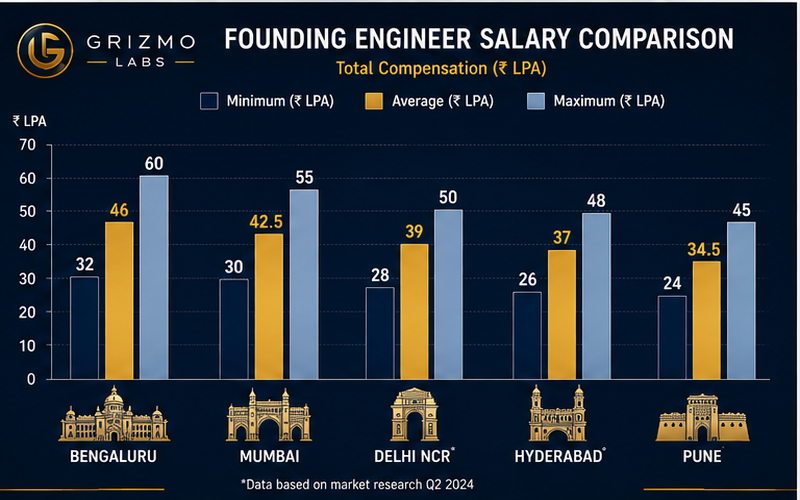
https://resources.instahyre.com/blog/ai-engineer-salary-in-india/Salary benchmarks, useful for budgeting before a search even starts, per Instahyre’s 2026 data:
| Level | Generalist ML | AI Engineer | GenAI / LLM Specialist |
|---|---|---|---|
| Fresher (0–1 yr) | ₹6–12 LPA | ₹8–14 LPA | ₹10–18 LPA |
| Mid (3–5 yr) | ₹16–30 LPA | ₹22–38 LPA | ₹26–45 LPA |
| Senior (8–11 yr) | ₹55–90 LPA | ₹65 LPA–1.2 Cr | ₹80 LPA–1.5 Cr |
| Staff / Principal (12+ yr) | ₹95 LPA–1.5 Cr | ₹1.1–1.8 Cr | ₹1.4–2.5 Cr |
GenAI and LLM specialists earn 25–40% more than generalist ML engineers at every level, per the same data. For how these India-based costs stack up against a US-based team, see India vs USA Hiring in 2026: What It Actually Costs.
The India AI Talent Market: What Changed This Year
A few figures worth knowing before you start a search in 2026:
- India holds an estimated 16% of the global AI talent pool, a share projected to grow toward 1.25 million AI professionals by 2027, per the India Skills Report 2026.
- AI engineering hiring grew 59.5% year-on-year, with tier-2 cities such as Hyderabad (+51%) and Vijayawada (+45.5%) growing faster than the traditional metro hubs, per LinkedIn’s AI Labor Market Report 2026.
- Over 90% of Indian employees report already using generative AI tools at work, per the India Skills Report 2026 — a sign the talent pool is deepening quickly, not just that job postings are increasing.
In practice, this means an agency that was adequate for a single ML hire in 2024 may not have kept pace with where the talent — and the competition for it — has moved in 2026. It’s a fair question to ask any agency directly: how has your sourcing footprint changed in the last 12 months?
Red Flags to Watch For
- No technical screening questions before they start submitting candidates.
- Promises of placement in under two weeks for a specialized or leadership role.
- Pressure for exclusivity before they’ve delivered a single strong candidate.
- No replacement guarantee, or a vague one they won’t put in writing.
- Pricing that isn’t disclosed until late in the conversation.
- A generalist recruiter equally comfortable staffing your accounts team and your ML team — specialization is the whole point.
How to Compare Agencies Before You Commit
- Write a precise brief — not “AI engineer,” but the specialization, seniority, and what “good” looks like in the first 90 days.
- Have a short technical conversation with each agency before sharing the brief widely. Listen for clarifying questions, not instant confidence.
- Ask for 2–3 candidate submissions as a pilot before signing a full retainer.
- Call two references directly — a CTO or founder, not a case study.
- Get the fee, timeline, and replacement terms in writing before the search starts.
FAQ
What’s the difference between an AI recruiting platform and an AI recruitment agency?
Platforms are software your team operates to screen or source faster; agencies run the search for you, from sourcing through shortlist. If you don’t have an internal recruiter driving the process day to day, you likely need an agency rather than a platform.
How much do AI recruitment agencies charge in India in 2026?
Most agencies charge 8.33%–16.67% of first-year CTC for specialist technical roles, rising to 20–25% for CXO-level searches. A handful of automated platforms charge a flat fee of around 7% instead.
How long does it take to fill a specialized AI or leadership role?
Realistically 3–6 weeks for a specialized individual-contributor role, and 4–8 weeks for a CTO or VP Engineering search, depending on how narrow the brief is and how confidential the search needs to be.
Can I run a search with more than one agency at the same time?
Yes, as long as you tell each agency you’re doing it. Most legitimate firms won’t ask for exclusivity until they’ve already shown they can deliver strong candidates.
What should I ask for if a placement doesn’t work out?
A written replacement guarantee, typically covering 90 days to 6 months, is standard practice in India’s recruitment market. Get the exact terms in writing before you sign, not after.
Choosing Your Partner
There’s no single “best” AI recruitment agency in India in 2026 — there’s a best fit for your stage, your role, and how much of the search you want to run yourself. Platforms suit teams with existing recruiting capacity; generalist staffing firms suit high-volume or broadly technical roles; specialist firms suit the hires that are hardest to define and most expensive to get wrong — a first founding engineer, a first AI hire, a CTO.
Grizmo Labs runs searches in that last category: confidential, headhunted hiring for founding engineers, AI talent, and technical leadership, structured around your startup’s actual stage rather than a one-size-fits-all process. Book a 30-minute strategy call — no commitment required.