
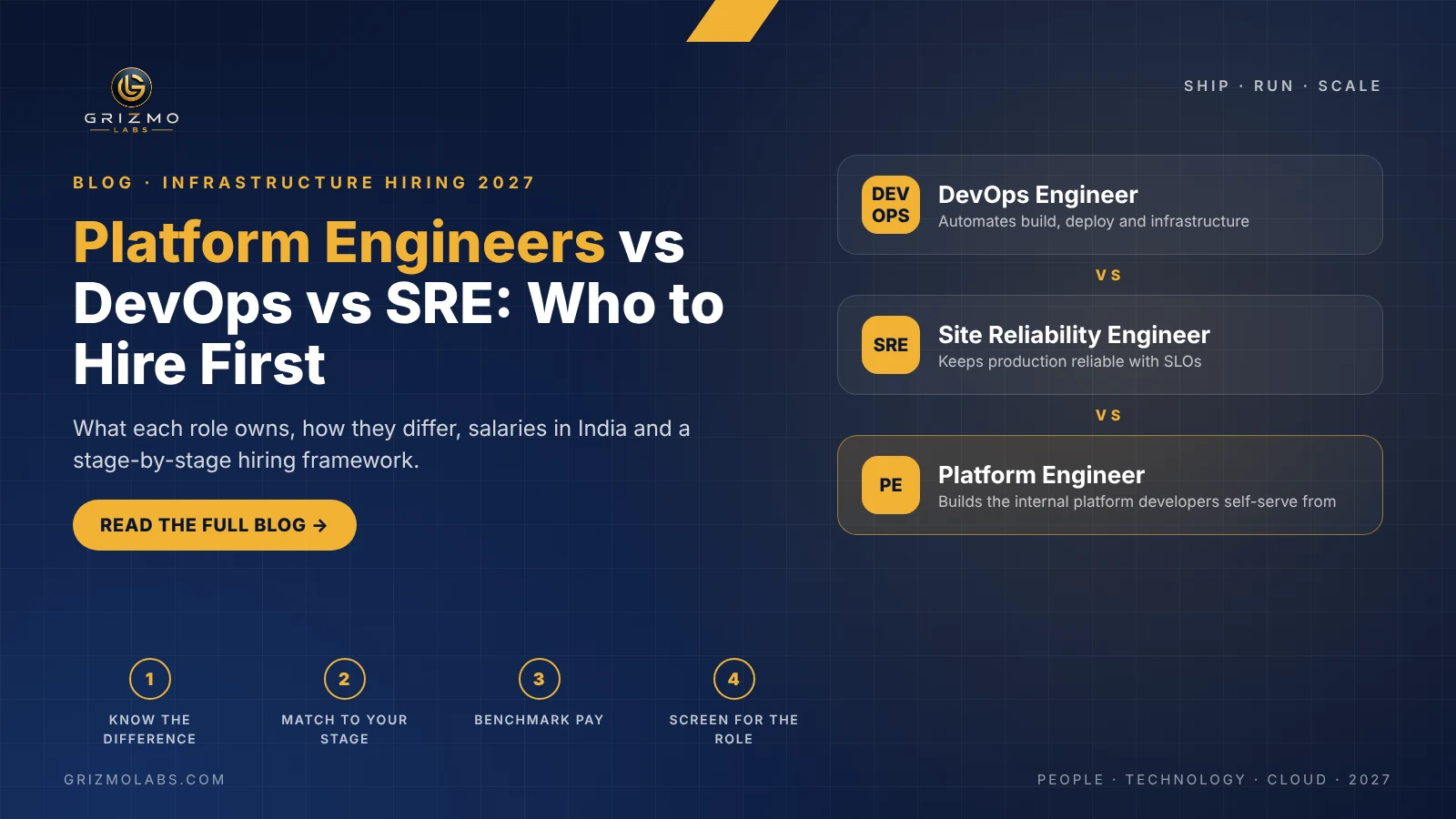
DevOps engineers automate how software is built and deployed. Site reliability engineers (SREs) keep production reliable using service level objectives and incident response. Platform engineers build the internal developer platform that lets every team ship on its own. Most startups should hire a DevOps engineer first, add an SRE when outages start costing customers, and hire platform engineers once three or more product teams are duplicating infrastructure work.
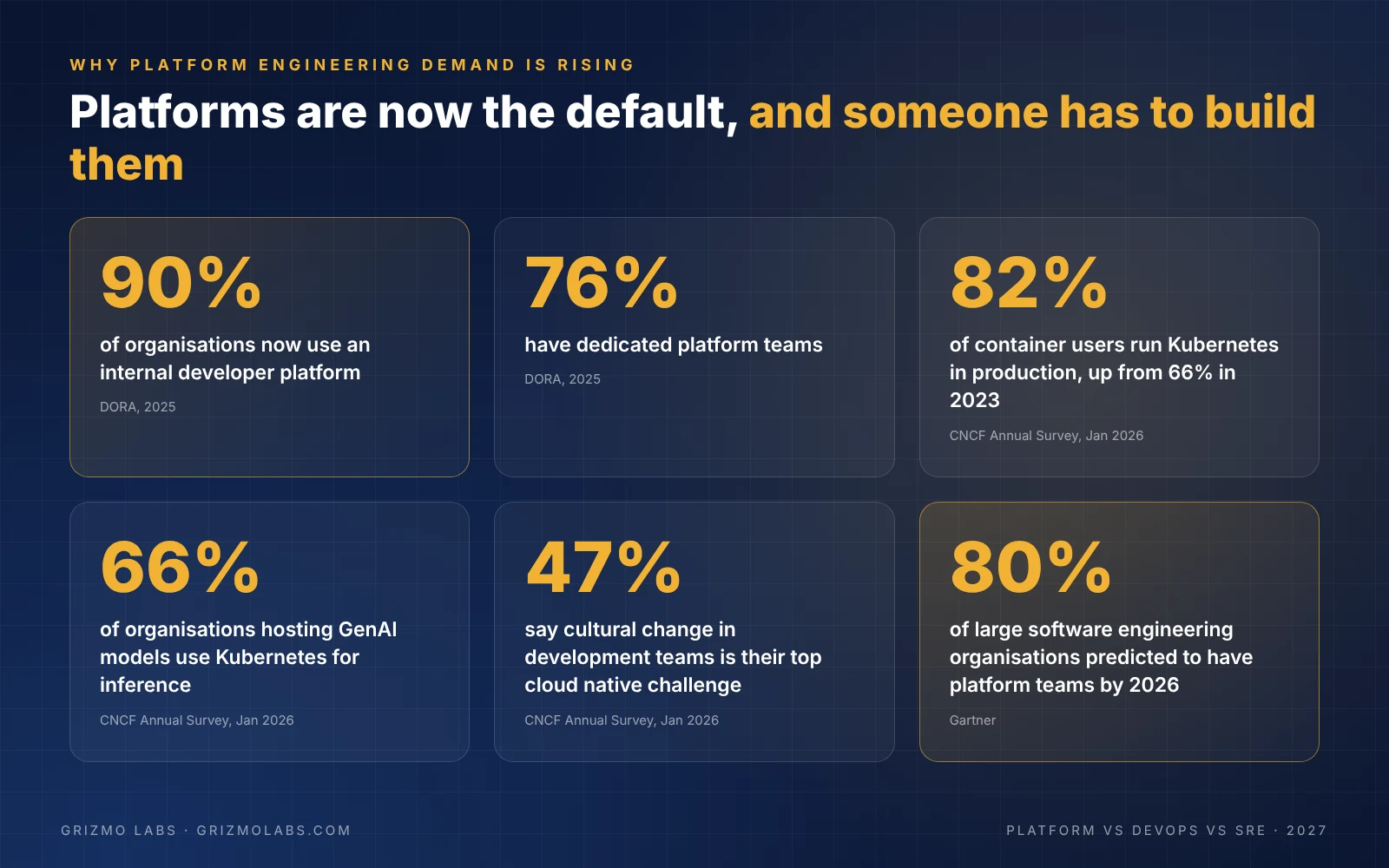
The choice matters more in 2027 because platforms have become the default. Google’s DORA research found that 90% of organisations now use an internal developer platform and 76% have dedicated platform teams. The CNCF’s latest survey shows 82% of container users run Kubernetes in production. Yet the three titles are still used interchangeably in job descriptions, which is one of the most common reasons infrastructure hires go wrong.
This guide compares the three roles side by side, gives you a simple framework for deciding who to hire first, and covers skills, salaries in India and the interview questions that separate them.
Key Takeaways
- DevOps engineers optimise delivery, SREs optimise reliability and platform engineers optimise developer self-service.
- 90% of organisations use an internal developer platform and 76% have dedicated platform teams (DORA, 2025).
- 82% of container users run Kubernetes in production, and 66% of organisations hosting GenAI models use it for inference (CNCF, January 2026).
- Hire DevOps first when releases are manual, an SRE when downtime costs money, and a platform engineer when multiple teams duplicate infrastructure.
- India pay bands: DevOps ₹12–24 LPA mid-level and ₹25–55 LPA senior (Second Talent); SREs and platform engineers typically command a premium.
In This Article
Quick Answer
DevOps engineer: automates CI/CD, infrastructure as code and deployments so teams ship faster. SRE: applies software engineering to operations, setting SLOs and error budgets and leading incident response so production stays reliable. Platform engineer: builds an internal developer platform, a set of self-service tools and “golden paths,” so developers can provision, deploy and observe their services without filing tickets. Ship → Run → Scale: DevOps helps you ship, SRE helps you run, platform engineering helps you scale.
DevOps vs SRE vs Platform Engineer at a Glance
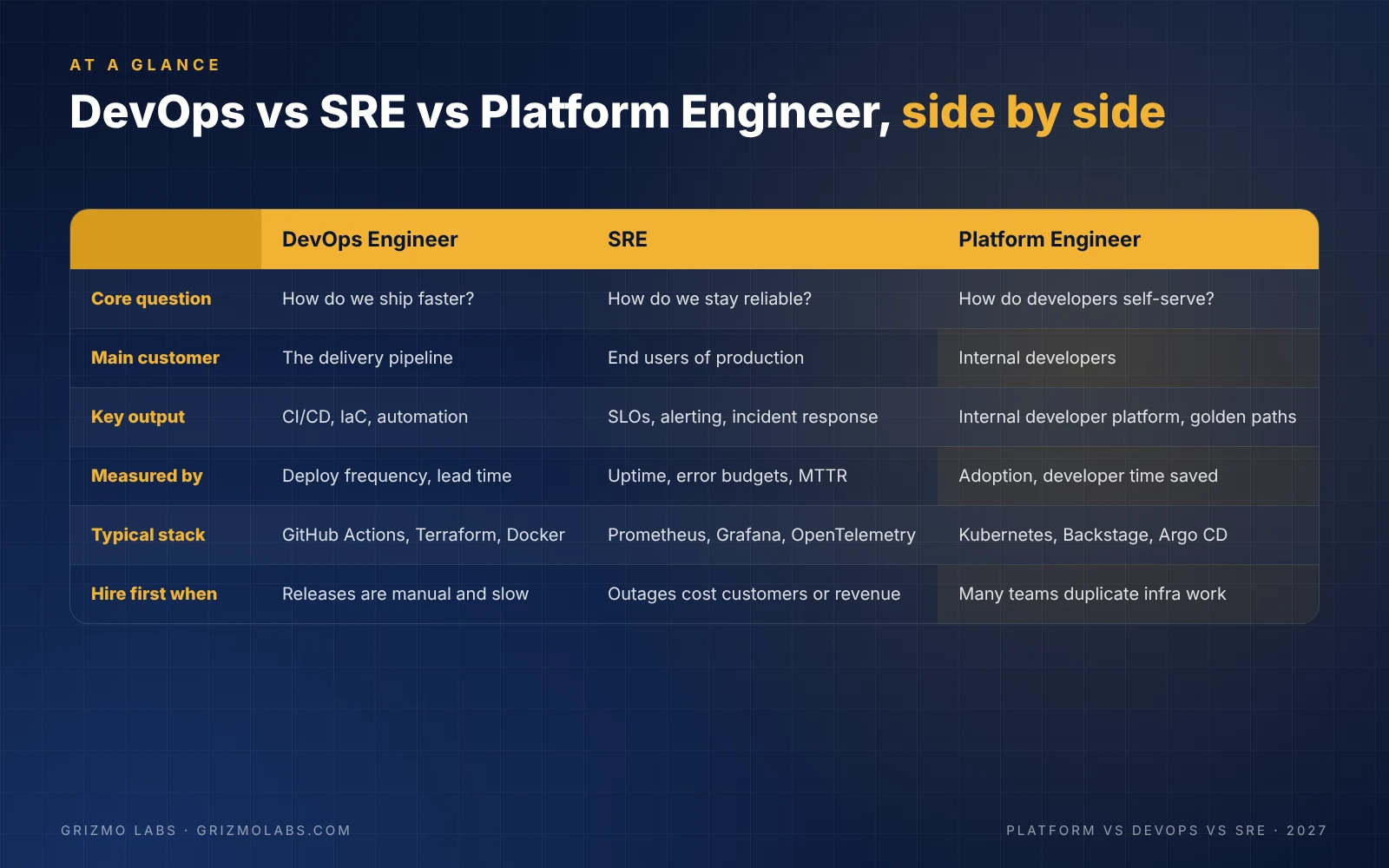
| Area | DevOps Engineer | Site Reliability Engineer | Platform Engineer |
|---|---|---|---|
| Core question | How do we ship faster and more safely? | How do we keep production reliable? | How do developers serve themselves? |
| Main customer | The delivery pipeline and engineering team | End users of production systems | Internal developers |
| Key output | CI/CD pipelines, infrastructure as code, automation | SLOs, error budgets, alerting, incident response, postmortems | Internal developer platform, golden paths, developer portal |
| Measured by | Deployment frequency, lead time, change failure rate | Availability, latency, error budget burn, time to restore | Platform adoption, developer time saved, onboarding time |
| Typical tools | GitHub Actions, GitLab CI, Jenkins, Terraform, Docker | Prometheus, Grafana, OpenTelemetry, PagerDuty | Kubernetes, Backstage, Argo CD, Crossplane, Terraform modules |
| On-call | Sometimes | Core part of the job | For the platform itself |
What Is a DevOps Engineer?
A DevOps engineer automates the path from code to production. They build CI/CD pipelines, manage cloud infrastructure as code, containerise applications and remove manual steps from releases. The DevOps movement emerged around 2009 to break down the wall between developers and operations, and the “DevOps engineer” title grew out of the people who did that automation work.
In practice, a DevOps engineer at a startup sets up the cloud account structure, writes the Terraform, builds the deployment pipeline, configures environments and secrets, and makes sure every engineer can deploy safely without asking for help.
What Is a Site Reliability Engineer (SRE)?
A site reliability engineer applies software engineering to operations problems. Google created the discipline in the early 2000s and later popularised it through its Site Reliability Engineering books. SREs define service level objectives (SLOs), track error budgets, build monitoring and alerting, lead incident response and run blameless postmortems.
The defining idea is the error budget: if a service is meant to be 99.9% available, the remaining 0.1% is a budget the team can “spend” on releases and experiments. When the budget runs out, reliability work takes priority over new features. That gives engineering and product a shared, numerical way to trade speed against stability.
What Is a Platform Engineer?
A platform engineer builds and runs an internal developer platform (IDP): the self-service tools, templates and paved roads that let product teams create services, provision infrastructure, deploy and observe their software without becoming infrastructure experts. Gartner defines platform engineering teams as groups that build shared, reusable services, components and tools delivered through platforms that support application delivery.
The key mindset is “platform as a product.” DORA describes the platform as an internal product with developers as its customers. Good platform engineers interview their users, measure adoption and remove friction, rather than handing out infrastructure tickets. Gartner has predicted that 80% of large software engineering organisations would have platform engineering teams by 2026.
DevOps vs SRE: What Is the Difference?
DevOps is mainly about delivery speed and automation; SRE is mainly about reliability in production. Google describes SRE as one concrete way of implementing DevOps principles, so the two are complementary rather than competing.
| Area | DevOps Engineer | SRE |
|---|---|---|
| Primary goal | Faster, safer releases | Reliable, measurable production |
| Works mostly on | Pipelines and infrastructure provisioning | Monitoring, incidents and capacity |
| Signature practice | Infrastructure as code and CI/CD | SLOs and error budgets |
| Coding depth | Scripting and automation | Often deeper software engineering to remove toil |
| When it hurts not to have one | Every release is manual and risky | Outages are frequent and nobody owns them |
DevOps vs Platform Engineer: What Is the Difference?
A DevOps engineer often does infrastructure work for teams. A platform engineer builds products that let teams do it themselves. As companies grow, a few DevOps engineers can no longer keep up with requests from many product teams, and platform engineering is the usual answer: turn repeated work into self-service.
| Area | DevOps Engineer | Platform Engineer |
|---|---|---|
| Delivery model | Builds and maintains pipelines and infrastructure | Builds self-service tools and golden paths |
| Interacts with developers by | Handling requests and pairing | Shipping a platform they adopt |
| Scale it suits | One to a few product teams | Three or more product teams |
| Product skills | Useful | Essential: user research, roadmaps, adoption metrics |
| Kubernetes depth | Working knowledge | Usually deep, often multi-cluster and multi-cloud |
SRE vs Platform Engineer: What Is the Difference?
SREs protect the reliability of the services customers use. Platform engineers protect the productivity of the developers who build those services. They work closely together: the platform should make reliable defaults (logging, metrics, tracing, safe rollouts) the easy path, and SREs help decide what those defaults should be.
| Area | SRE | Platform Engineer |
|---|---|---|
| Customer | End users | Internal developers |
| Success looks like | SLOs met, fast recovery from incidents | Teams ship without filing infrastructure tickets |
| Main risk they reduce | Downtime and degraded performance | Slow delivery, inconsistency and duplicated work |
| Typical first project | Define SLOs and fix alerting noise | A golden path for creating and deploying a new service |
Who Should You Hire First in 2027?
Use the Grizmo Labs infrastructure hire framework. Answer three questions in order and stop at the first “yes.”
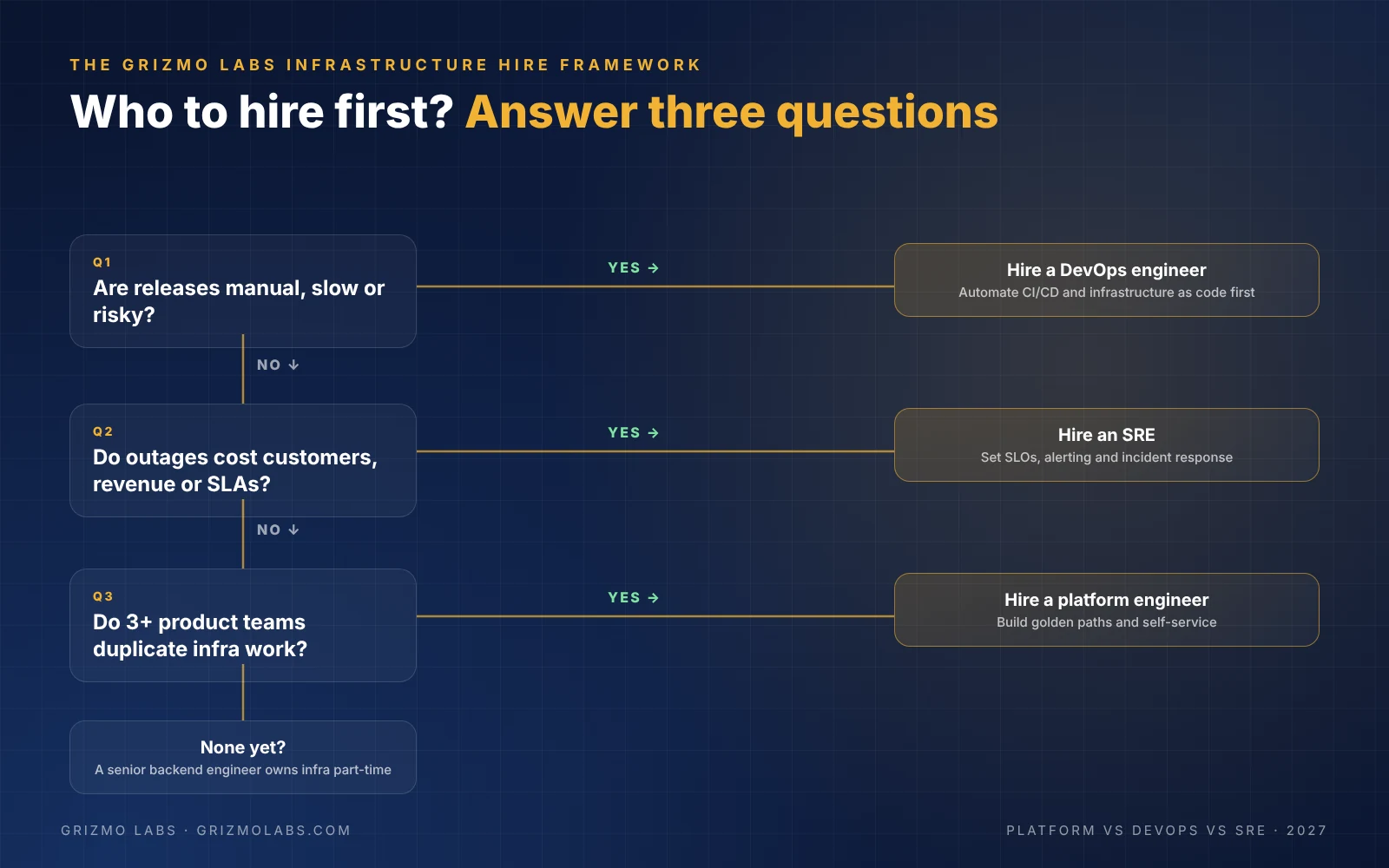
- Are releases manual, slow or risky? Hire a DevOps engineer. You cannot build a platform or meet SLOs on top of hand-run deployments.
- Do outages cost customers, revenue or contractual SLAs? Hire an SRE. This often arrives with your first enterprise or regulated customer, especially in fintech and healthtech.
- Do three or more product teams duplicate infrastructure work? Hire a platform engineer. Repeated tickets and inconsistent setups are the clearest sign that self-service will pay off.
- None of these yet? Let a senior backend or founding engineer own infrastructure part-time. Our guide on founding engineer roles and responsibilities covers what that looks like.
AI products add a fourth consideration. The CNCF found that 66% of organisations hosting generative AI models use Kubernetes for some or all inference, and DORA reports that strong platforms amplify the benefits of AI adoption while weak ones leave them negligible. If you are building agentic AI products, GPU scheduling, model serving and cost controls push platform and SRE hires earlier.
Who to Hire at Each Startup Stage
| Stage | Typical team | Recommended infrastructure hire |
|---|---|---|
| Pre-seed / Seed | 1–2 product teams | No dedicated hire; a senior backend engineer owns infrastructure, using managed cloud services |
| Series A | 2–4 product teams | First DevOps engineer, ideally one with SRE habits (monitoring, on-call, postmortems) |
| Series B | 4–8 product teams | First dedicated SRE, plus your first platform engineer or a small platform team |
| Series C+ / GCC | 8+ product teams | A platform team run as a product, an SRE team with clear service ownership, and DevOps skills embedded in both |
Regulated sectors such as fintech should bring reliability hires forward one stage. Our technical hiring pipeline guide covers how to sequence engineering hires more broadly.
Skills That Matter for Each Role
DevOps engineer
- CI/CD design (GitHub Actions, GitLab CI or Jenkins) with testing, security scanning and safe rollbacks
- Infrastructure as code with Terraform or OpenTofu, plus Docker and working Kubernetes knowledge
- Cloud fundamentals on AWS, Azure or GCP: networking, IAM, secrets and cost basics
- Strong scripting in Bash and Python or Go
Site reliability engineer
- SLO design, error budgets and alerting that pages on symptoms, not noise
- Observability with Prometheus, Grafana and OpenTelemetry: metrics, logs and traces
- Incident command, blameless postmortems and capacity planning
- Software engineering in Go or Python to automate away toil, plus deep Linux and networking
Platform engineer
- Deep Kubernetes, often multi-cluster and multi-cloud, with GitOps tools such as Argo CD or Flux
- Developer portals and golden paths (Backstage or similar), service templates and reusable Terraform modules
- Platform security: policy as code, secrets management and supply-chain controls, often shared with cloud security teams
- Product thinking: user interviews with developers, adoption metrics and a platform roadmap
DevOps, SRE and Platform Engineer Salaries in India
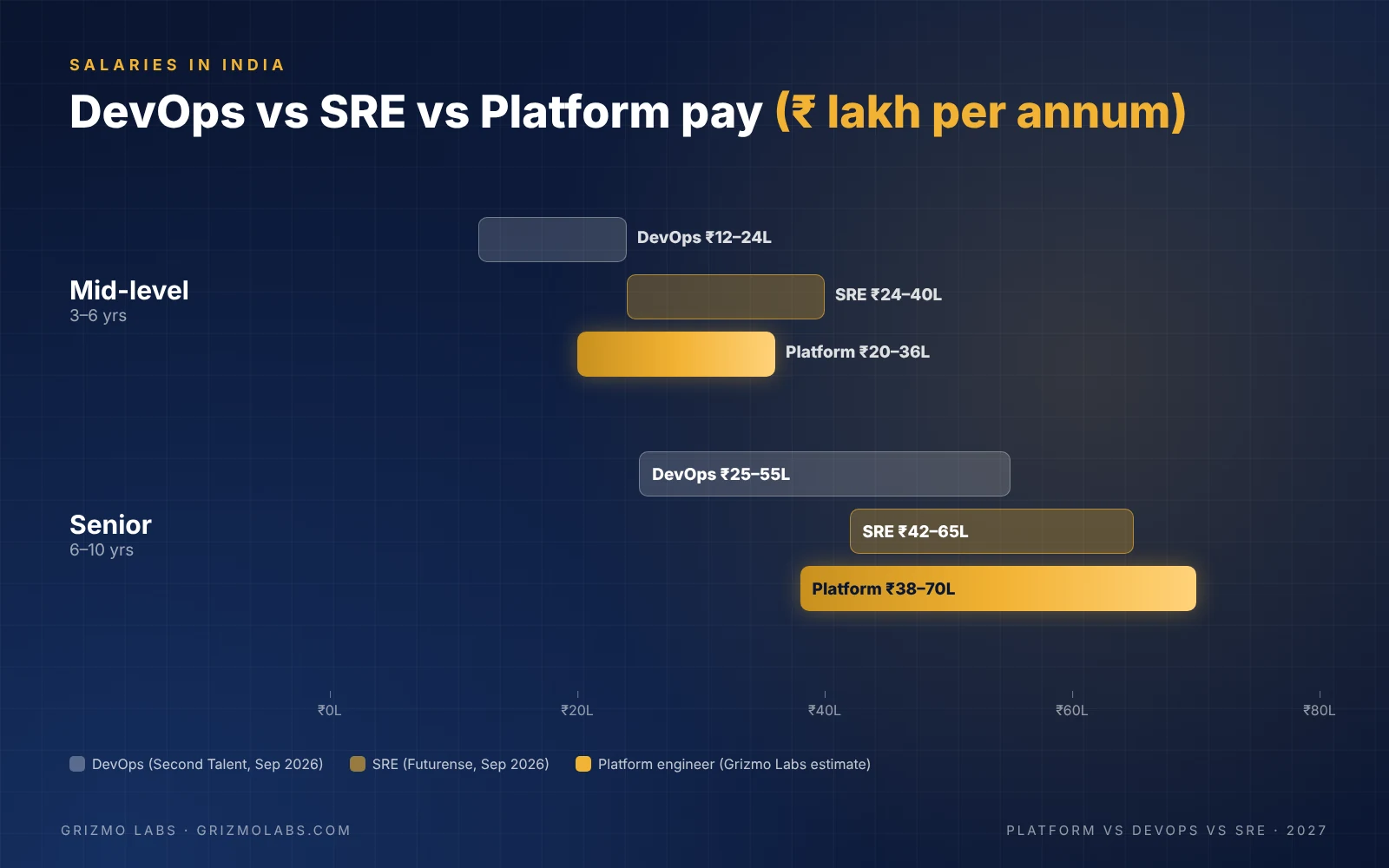
| Level | DevOps Engineer | SRE | Platform Engineer |
|---|---|---|---|
| Junior (0–2 years) | ₹5.5–12 LPA | ₹6–12 LPA | Rarely hired at this level |
| Mid-level (3–6 years) | ₹12–24 LPA | ₹24–40 LPA | ₹20–36 LPA |
| Senior (6–10 years) | ₹25–55 LPA | ₹42–65 LPA | ₹38–70 LPA |
| Lead / Principal | ₹48–85 LPA | ₹50–78 LPA average; top performers higher | Benchmark against lead DevOps and SRE bands |
How to Read These Numbers
DevOps bands are from Second Talent’s September 2026 rate card for India, which also lists $50–85 per hour for platform engineers running multi-cluster Kubernetes for international clients. SRE bands are from Futurense (September 2026), which does not name its data sources, so treat them as directional. The platform engineer column is a Grizmo Labs estimate based on current search activity; deep Kubernetes, multi-cloud and GPU platform experience commands the top of the range.
For global companies comparing costs, our India vs USA hiring cost guide covers the full employer cost. Bengaluru, Hyderabad and Pune have the deepest infrastructure talent pools, with strong SRE communities around large product companies and Global Capability Centres.
How to Screen DevOps, SRE and Platform Engineers
DevOps engineer screening
- “Walk me through the pipeline you built most recently. How does a bad release get rolled back?”
- “How do you structure Terraform state and modules across environments?”
- Practical: fix a broken CI pipeline and add a security scan in 60 minutes.
SRE screening
- “How would you choose SLOs for a payments API? What happens when the error budget runs out?”
- “Tell me about an incident you led. What did the postmortem change?”
- Practical: a live incident simulation with dashboards, logs and a degraded service.
Platform engineer screening
- “How would you design a golden path for a team creating a new microservice?”
- “How do you know if developers actually like your platform? What metrics would you track?”
- Practical: design a self-service environment workflow on Kubernetes, including guardrails and cost limits.
Common Infrastructure Hiring Mistakes
- Writing one JD for three roles. “DevOps/SRE/Platform Engineer” attracts generalists and puts off specialists.
- Hiring a platform team too early. With one or two product teams, a platform becomes a solution looking for a problem.
- Hiring an SRE without giving them authority. Error budgets only work if product leaders agree to pause features when they run out.
- Treating DevOps as a ticket queue. If your DevOps engineer only handles requests, you need either more automation or a platform.
- Ignoring culture. The CNCF found that cultural change in development teams is the top cloud native challenge, cited by 47% of respondents. Tools alone do not fix that.
- Testing only tool trivia. Knowing Kubernetes commands is not the same as designing reliable, self-service systems.
Infrastructure Hiring Checklist
- Your current pain is named: slow releases, outages or duplicated infrastructure
- The role is chosen using the three-question framework
- The JD names one role, with its real metrics (deploy frequency, SLOs or adoption)
- The pay band reflects role and depth, with a premium for Kubernetes and multi-cloud
- The practical exercise matches the role: pipeline fix, incident simulation or platform design
- On-call expectations are written down before the offer
- The first 90-day goal is agreed: automated deploys, SLOs live or one golden path adopted
The Grizmo Labs Perspective
The most common mistake we see is not choosing the wrong role. It is not choosing at all, and writing a job description that asks one person to be a DevOps engineer, an SRE and a platform team at once. The best infrastructure hires are clear about which problem they own, and they are measured on it.
Our advice for 2027: start with automation, earn reliability, then build a platform when your teams are asking for one. Hiring in that order keeps each role focused and makes the next hire easier to justify.
Conclusion
DevOps, SRE and platform engineering are three answers to three different problems: shipping, running and scaling. Pick the problem that hurts most today, hire the role built for it, and measure them on the outcome that role exists to improve.
Frequently Asked Questions
What is the difference between DevOps, SRE and platform engineering?
DevOps engineers automate building and deploying software. SREs keep production reliable using SLOs, error budgets and incident response. Platform engineers build internal developer platforms so product teams can provision, deploy and observe services through self-service.
Should a startup hire a DevOps engineer or an SRE first?
Most startups should hire a DevOps engineer first, because reliable automation is the foundation everything else depends on. Hire an SRE when outages start costing customers, revenue or contractual SLAs, which often happens with the first enterprise customers.
When does a company need a platform engineer?
Usually when three or more product teams are duplicating infrastructure work, filing repeated tickets or running inconsistent setups. At that point, self-service golden paths save more time than adding more DevOps engineers.
Is platform engineering replacing DevOps?
No. Platform engineering is an evolution of DevOps practices at scale. DevOps principles remain, but instead of each team building its own pipelines and infrastructure, a platform team packages them into self-service tools.
How much do DevOps, SRE and platform engineers earn in India?
Mid-level DevOps engineers earn about ₹12–24 LPA and senior DevOps engineers ₹25–55 LPA (Second Talent, September 2026). SREs and platform engineers typically earn more, with senior platform engineers estimated at ₹38–70 LPA depending on Kubernetes and multi-cloud depth.
Is SRE the same as DevOps?
Not exactly. Google describes SRE as one way of implementing DevOps principles, with a specific focus on reliability, measured through SLOs and error budgets. DevOps is a broader set of practices focused on collaboration and automated delivery.
Sources and Methodology
Figures come from the sources below, accessed in November 2026. Salary data comes from rate cards and salary guides with varying methodologies, and the platform engineer column is labelled as a Grizmo Labs estimate.
- DORA: Platform engineering capability (2024 and 2025 research)
- CNCF: Annual Cloud Native Survey 2025 (20 Jan 2026)
- Gartner: Platform engineering empowers developers
- Google: Site Reliability Engineering books
- Second Talent: DevOps engineer salary and rate card, India (14 Sep 2026)
- Futurense: Site reliability engineer salary in India (5 Sep 2026)
Hire DevOps, SRE and Platform Engineers with Grizmo Labs
The right first infrastructure hire saves months of firefighting. The wrong one leaves you with a platform nobody uses or an on-call rota nobody owns.
Grizmo Labs hires DevOps engineers, SREs, platform engineers and infrastructure leaders across India for SaaS companies, fintechs and global teams, with deep talent pools in Hyderabad, Pune and Bengaluru.