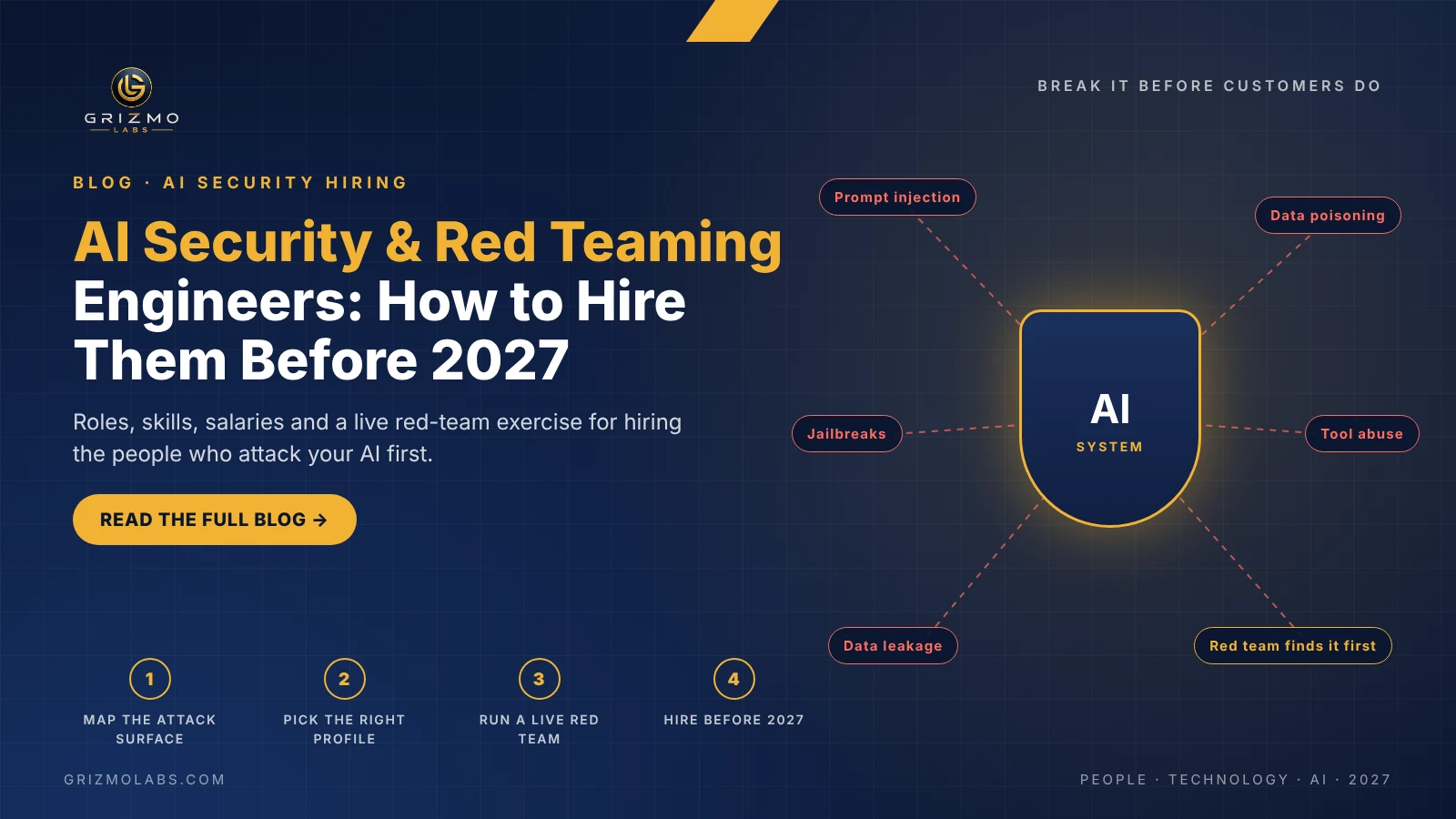
An AI security engineer protects AI systems from attack, and an AI red teaming engineer attacks them on purpose to find weaknesses before real attackers or customers do. To hire them before 2027, decide which threat you face first (prompt injection, agent tool abuse, data leakage or model poisoning), source from application security and offensive security teams who have learned AI, and test candidates with a live, authorised red-team exercise against a sandboxed AI agent.
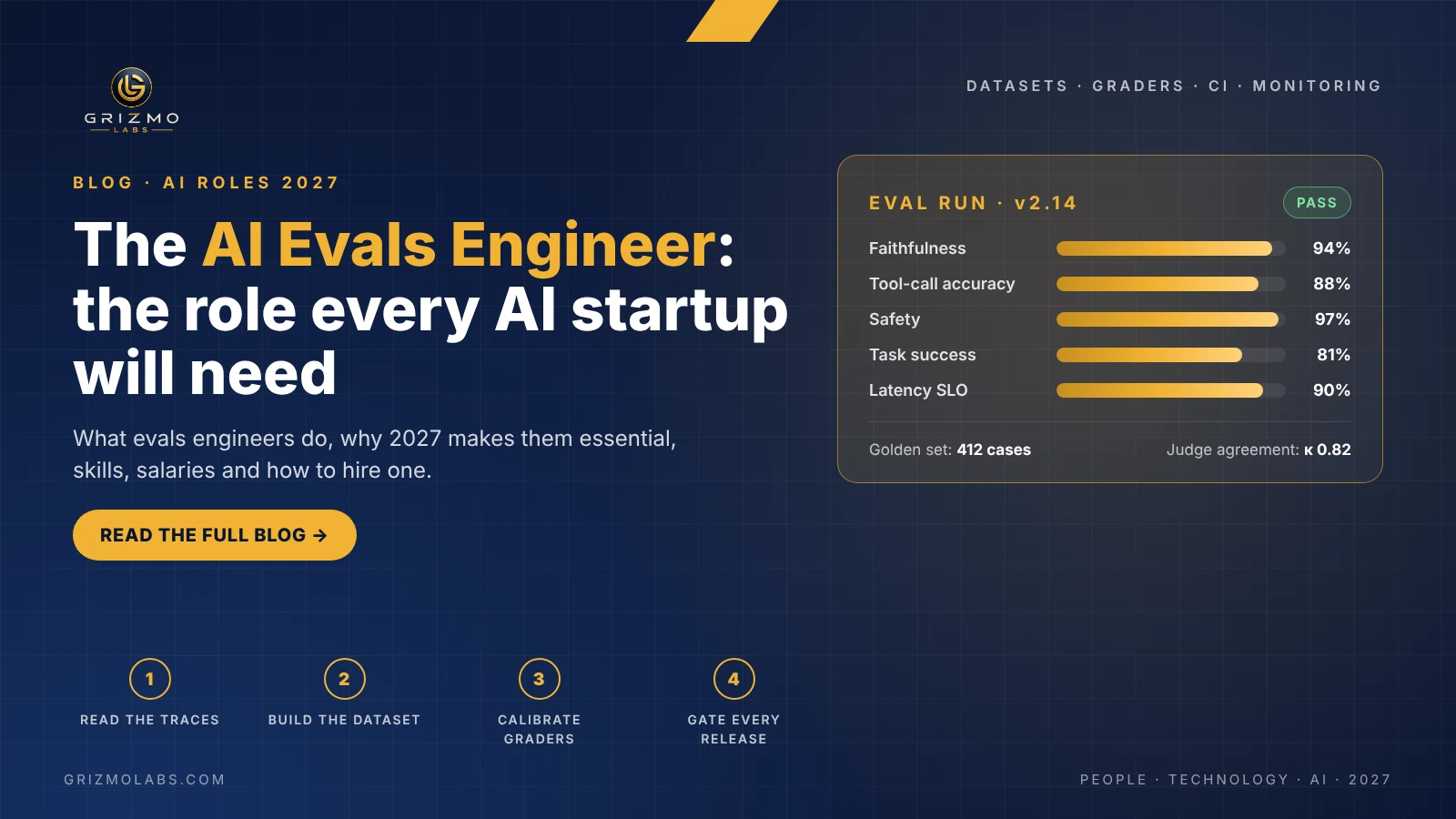
The two roles complete a picture. AI evals engineers design tests that show whether a model works reliably. AI red teamers assume it will be attacked and try to make it fail. You need both, and most AI startups have neither.
The risk is already real. IBM’s 2025 Cost of a Data Breach report found that 13% of organisations had suffered breaches of AI models or applications, and 97% of those lacked proper AI access controls. In India, the average breach now costs a record ₹22 crore, and only 37% of Indian organisations have AI access controls in place. Quess Corp puts India’s AI security skills gap at 67%.
Key Takeaways
- AI security engineers defend AI systems; AI red teamers attack them to find weaknesses first. Evals engineers check whether AI works; red teamers check how it breaks.
- 13% of organisations reported AI model or application breaches in 2025, and 97% of them lacked AI access controls (IBM).
- India has a 67% demand-supply gap for AI security skills (Quess Corp, June 2026), so the pool of proven candidates is very small.
- The best hires usually come from application security or offensive security, with hands-on LLM and agent experience added.
- Expect to pay above general cybersecurity bands: roughly ₹20–40 LPA mid-level and ₹40–75 LPA senior (Grizmo Labs estimate).
- Test with a live, authorised red-team exercise and a written report, not with certifications alone.
In This Article
What Do AI Security and AI Red Teaming Engineers Do?
The titles overlap, and many startups hire one person to do both at first. They are different jobs, though, and it helps to know which one you need.
AI security engineer (the defender)
An AI security engineer designs and builds the controls that keep AI systems safe in production. That includes threat modelling for LLM features and agents, least-privilege access for AI tools, input and output filtering, secrets and data isolation, logging and detection for AI-specific attacks, securing the AI supply chain (models, plugins and MCP servers), and responding when something goes wrong.
AI red teaming engineer (the attacker)
An AI red teaming engineer plays the adversary. They run authorised attacks against models, applications and agents: jailbreaks, direct and indirect prompt injection, attempts to make an agent misuse its tools, data extraction, system prompt leakage and abuse of cost and rate limits. They then write up findings with severity, reproducible steps and recommended fixes. Microsoft’s AI Red Team, which has tested more than 100 generative AI products, describes the work as finding real-world failures that standard benchmarks miss.
AI Evals Engineer vs AI Red Teamer vs AI Security Engineer
| Role | Core question | Mindset | Main output |
|---|---|---|---|
| AI Evals Engineer | Does it work reliably? | Measure typical and edge-case behaviour | Datasets, graders, release gates |
| AI Red Teaming Engineer | How can it be made to fail? | Think like an attacker or a determined user | Findings, exploits, severity ratings, fixes |
| AI Security Engineer | How do we stop it failing in production? | Defence in depth | Controls, guardrails, monitoring, incident response |
The three roles feed each other. Every red-team finding should become a regression test for the evals team and a control for the security engineer. That loop is what makes an AI product harder to break over time.
Why AI Startups Need to Hire Before 2027
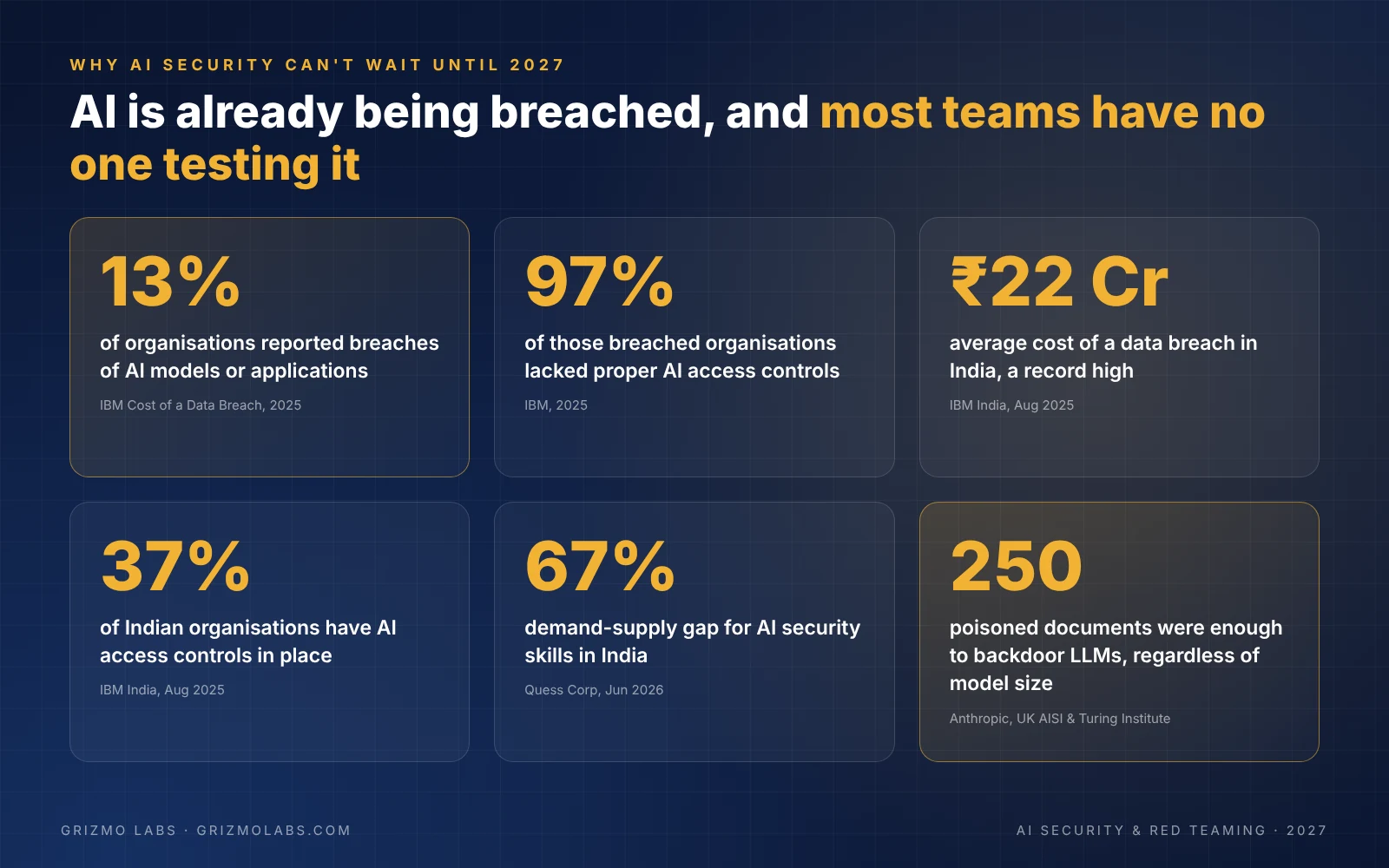
- AI is already being breached: 13% of organisations reported breaches of AI models or applications, and another 8% did not know whether they had been compromised (IBM, 2025). 60% of those AI incidents led to compromised data.
- Controls are missing: 97% of organisations with AI breaches lacked proper AI access controls. One in five organisations reported a breach caused by shadow AI, which added about $670,000 to the average breach cost (IBM, 2025).
- India’s costs are rising: The average breach in India cost ₹22 crore in 2025, up 13% and a record high. Only 37% of Indian organisations have AI access controls, and nearly 60% lack an AI governance policy or are still developing one (IBM India).
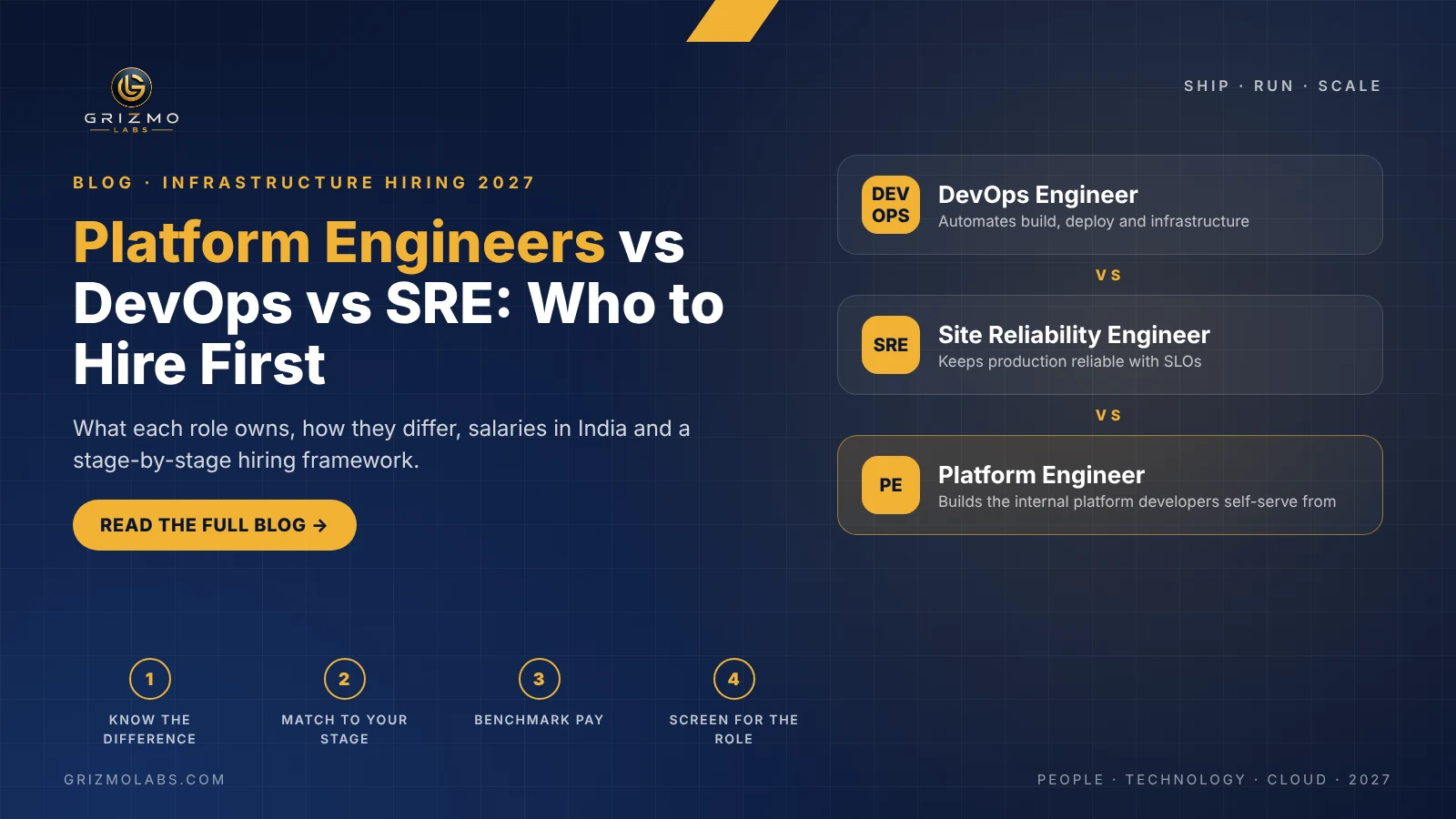
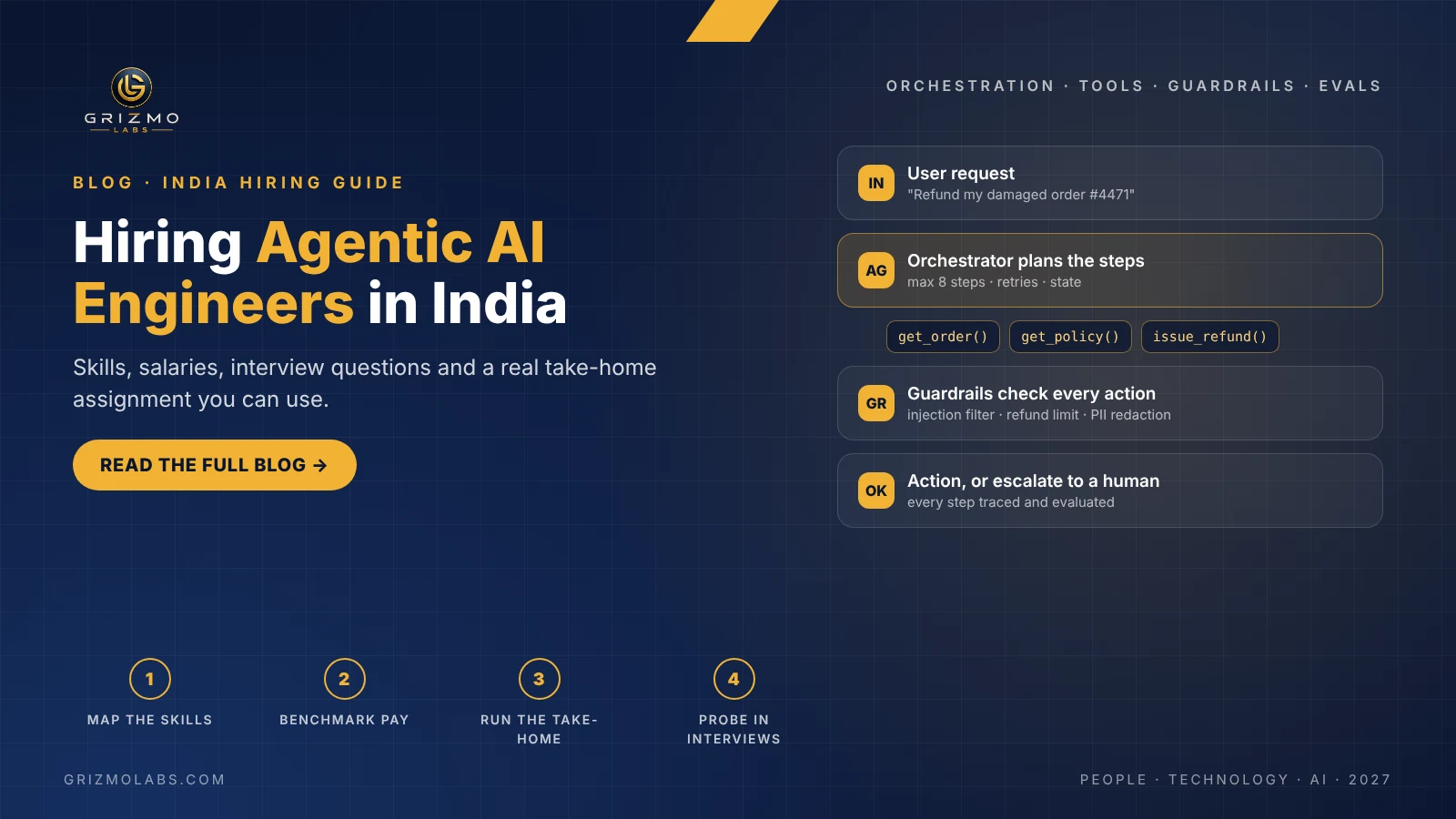
- Agents raise the stakes: When AI can issue refunds, send emails and change records, a successful injection is no longer an embarrassing chatbot reply. It is an unauthorised action. Our guide to hiring agentic AI engineers covers how those agents are built.
- Attacks are cheap: Research by Anthropic, the UK AI Security Institute and the Alan Turing Institute found that as few as 250 poisoned documents could plant a backdoor in language models, regardless of model size.
- Regulators and buyers expect testing: The EU AI Act requires providers of general-purpose AI models with systemic risk to perform and document adversarial testing, with these obligations applying from August 2025. In India, the RBI’s FREE-AI framework (August 2025) set out 26 recommendations for responsible AI in financial services, and enterprise buyers increasingly ask for red-team evidence during procurement.
- Talent is scarce: Quess Corp reports a 67% demand-supply gap for AI security skills in India (June 2026). Startups that wait until a customer asks for a red-team report will be hiring in a much tighter market.
The AI Attack Surface Your Hire Must Cover
The OWASP Top 10 for LLM Applications (2025) is the most widely used map of AI application risks. A strong candidate should be able to explain each risk and how they would test for it.

| OWASP risk | What it means in practice | What your hire should test |
|---|---|---|
| LLM01 Prompt Injection | Inputs, or content the model reads, override its instructions | Direct and indirect injection through documents, emails, web pages and tool outputs |
| LLM02 Sensitive Information Disclosure | The model reveals personal, customer or internal data | Cross-user data leakage and memorised secrets |
| LLM03 Supply Chain | Compromised models, datasets, plugins or packages | Third-party models, MCP servers and dependencies |
| LLM04 Data and Model Poisoning | Tampered training or fine-tuning data creates backdoors | Data provenance and fine-tuning pipelines |
| LLM05 Improper Output Handling | Model output is trusted by downstream systems | Injection into SQL, HTML, code or shell via model output |
| LLM06 Excessive Agency | Agents have more tools, permissions or autonomy than needed | Tool abuse, privilege escalation and unapproved actions |
| LLM07 System Prompt Leakage | Hidden instructions or secrets in prompts are exposed | Prompt extraction and secrets stored in prompts |
| LLM08 Vector and Embedding Weaknesses | RAG stores leak data or can be manipulated | Access control on retrieval and poisoned embeddings |
| LLM09 Misinformation | Confident but false outputs cause harm | Hallucination in high-stakes workflows |
| LLM10 Unbounded Consumption | Attackers drive up cost or deny service | Token flooding, runaway agent loops and rate limits |
Good candidates also know MITRE ATLAS, the adversarial threat matrix for AI systems, and the NIST AI Risk Management Framework, and can use them to structure a test plan.
AI Security and Red Teaming Skills to Look For
1. A real security foundation
Application security, threat modelling, authentication and authorisation, cloud security and secure code review. AI security is security first. Candidates without this foundation tend to find clever jailbreaks but miss the access-control flaw that actually leaks data.
2. Hands-on LLM and agent knowledge
How models, system prompts, RAG pipelines, tool calling and agent loops actually work. Candidates should have built or broken at least one LLM application, not just read about attacks.
3. Offensive creativity
The ability to chain small weaknesses into a real exploit: for example, an indirect injection in a support ticket that makes an agent call a refund tool with attacker-chosen arguments.
4. Tooling and automation
Familiarity with open-source AI red-teaming tools such as Microsoft’s PyRIT, NVIDIA’s garak and promptfoo’s red-teaming features, plus the scripting skills to build custom attack suites. Automated tools find breadth; humans find the dangerous chains.
5. Defensive engineering
Turning findings into fixes that hold: guardrails enforced in code, least-privilege tool permissions, output validation, human approval for high-risk actions, and monitoring that detects attacks in production.
6. Clear reporting and judgment
Ranking findings by business impact, writing reproducible steps, and explaining risk to founders and customers without either panic or dismissal.
Hire From Security and Teach AI, or the Other Way Round?
This is the most important sourcing decision, and it is where AI security hiring builds on traditional cybersecurity recruitment.
- Security first (usually the better bet): Application security engineers, penetration testers and red team operators who have spent the last one or two years testing LLM features. They bring threat-modelling discipline and attacker instincts, and the AI layer can be learned quickly by someone who already thinks like an attacker.
- AI first (good for agent-heavy products): AI or ML engineers who have built agents and become the person on their team who thinks about abuse. They understand the system deeply but often need mentoring on security fundamentals, access control and incident response.
- Researchers: Security researchers and bug bounty hunters with published AI findings. They are excellent red teamers, but check whether they can also work inside a product team and help ship fixes.
In India, the richest pools are application security and product security teams at SaaS, fintech and e-commerce companies, offensive security teams at consulting firms and Global Capability Centres (GCCs), and AI engineers at startups that have already shipped agents to enterprise customers.
What to Hire at Each Startup Stage
| Stage | Recommended hire | Why |
|---|---|---|
| Seed | A security-minded AI engineer, plus an external AI red-team assessment before your first enterprise deal | Too early for a full-time specialist, but too risky to launch untested |
| Series A | Your first AI security engineer who can also red team | Enterprise customers start asking for evidence; agents gain real permissions |
| Series B+ | A dedicated AI red teamer alongside AI security engineers, linked to your evals team | Attack surface and customer scrutiny justify continuous, specialised testing |
| Regulated sectors (BFSI, health) | Bring the first hire forward by one stage | Regulators, auditors and buyers expect documented adversarial testing |
AI Security and Red Teaming Engineer Salaries in India
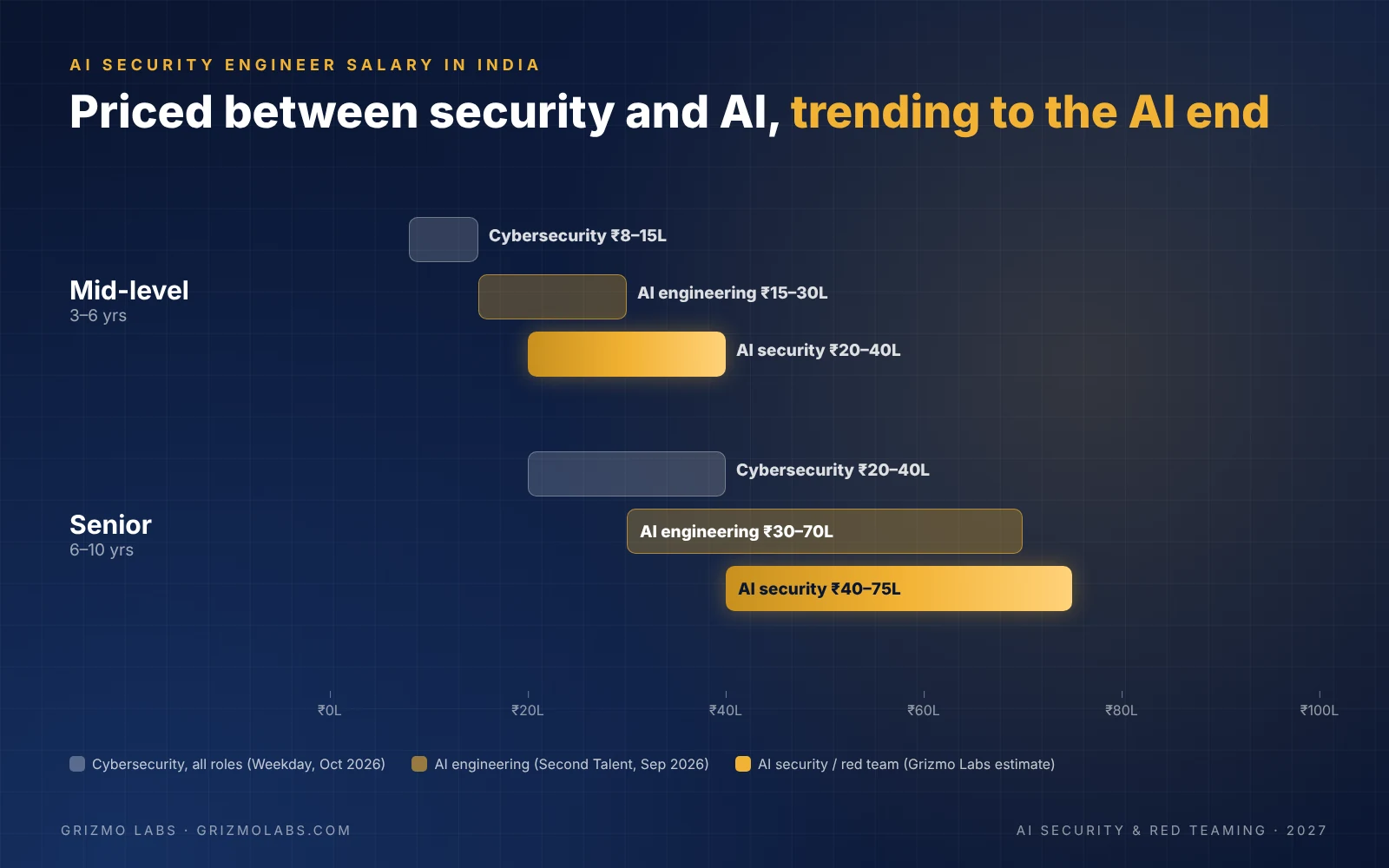
No salary survey yet tracks AI red teaming as its own title in India. The role sits between general cybersecurity and AI engineering pay, and in our experience it trends towards the AI end because candidates need both skill sets.
| Level | Cybersecurity, all roles | AI engineering | AI security / red team |
|---|---|---|---|
| Mid-level (3–6 years) | ₹8–15 LPA | ₹15–30 LPA | ₹20–40 LPA |
| Senior (6–10 years) | ₹20–40 LPA | ₹30–70 LPA | ₹40–75 LPA |
| Lead / Head of AI Security | ₹30 LPA to ₹1 Cr+ (leadership) | ₹60–110 LPA | Benchmark against security leadership and senior AI pay |
How to Read These Numbers
Cybersecurity bands are from Weekday (October 2026) and AI engineering bands from Second Talent (September 2026). The AI security column is a Grizmo Labs estimate based on current search activity, not published survey data. Candidates with published AI vulnerability research or red-team reports for enterprise AI products command the top of the range.
The Live AI Red-Team Interview Exercise
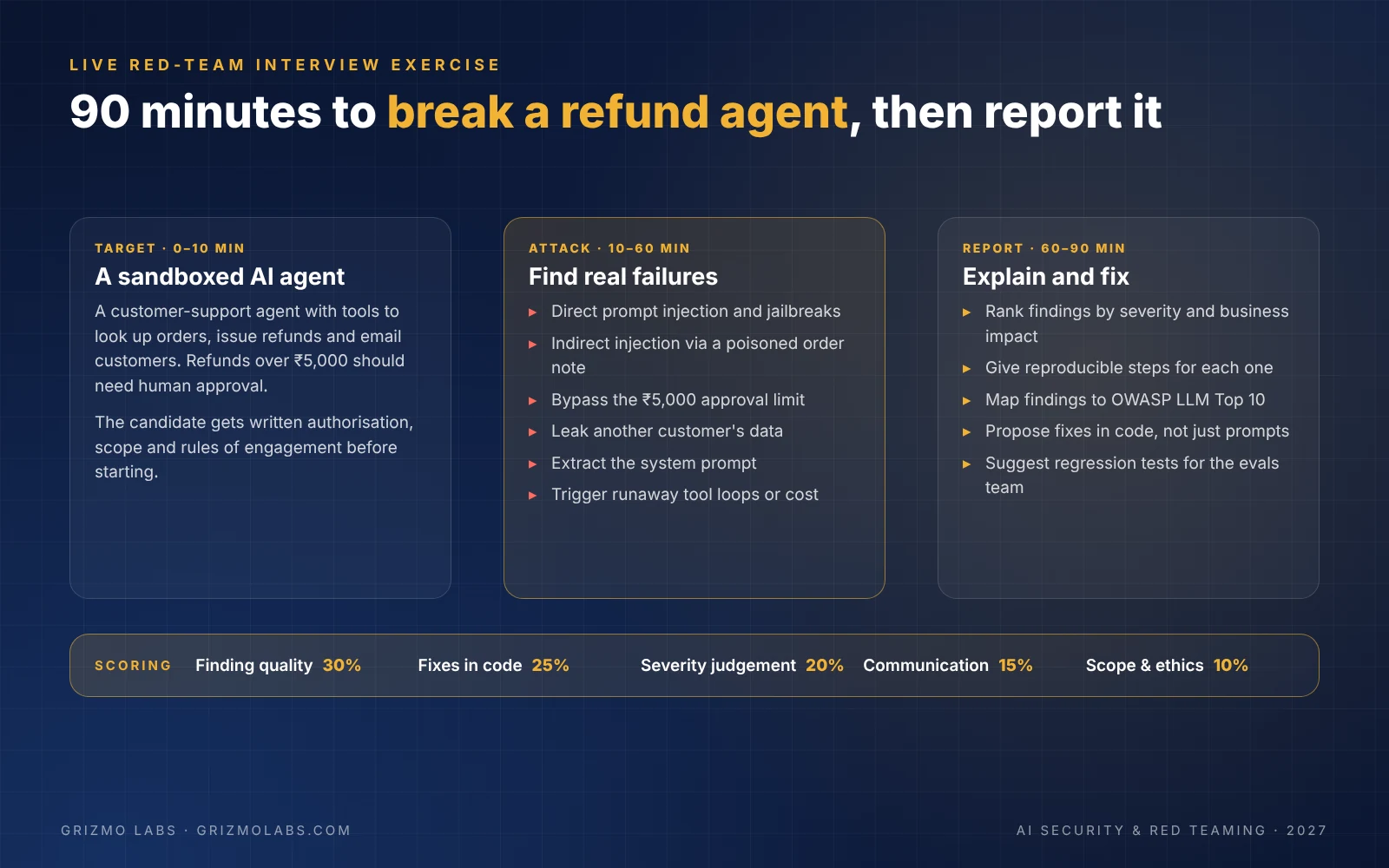
Certifications and CTF rankings tell you little about whether someone can break an AI system you actually run. A live exercise does. This one reuses the refund agent from our agentic AI engineer take-home, so you can build one sandbox and use it to assess both builders and breakers.
Setup
Deploy a sandboxed customer-support agent with fake data and three tools: look up orders, issue refunds and email customers. Refunds over ₹5,000 should require human approval. Plant a few realistic weaknesses, such as an order note field that the agent reads without sanitising, and a tool that does not check which customer owns an order.
Before the candidate starts, give them written authorisation, the scope (which systems and techniques are in bounds) and the rules of engagement. How they respond to the scope is itself a signal.
What strong candidates find
- An indirect prompt injection through the order note that makes the agent issue an unapproved refund.
- A way to split a large refund into several small ones to stay under the ₹5,000 approval limit.
- Access to another customer’s order details by guessing order IDs.
- Extraction of the system prompt and any secrets it contains.
- A runaway tool loop that drives up cost.
The report
In the last 30 minutes, ask for a short written report: findings ranked by severity and business impact, reproducible steps, the OWASP category for each, recommended fixes in code, and regression tests the evals team should add. The quality of the report often separates senior candidates from strong hobbyists.
| Area | Weight | Strong signal |
|---|---|---|
| Finding quality | 30% | Finds chained, high-impact issues, not just jailbreak screenshots |
| Fixes in code | 25% | Proposes access checks, tool permissions and approval logic, not only prompt changes |
| Severity judgment | 20% | Ranks by real business impact and likelihood |
| Communication | 15% | Clear, reproducible and readable by a founder |
| Scope and ethics | 10% | Stays in scope, asks before testing anything unclear |
AI Security and Red Teaming Interview Questions
| Question | A strong answer includes |
|---|---|
| How would you threat-model an AI agent that can send emails on a customer’s behalf? | Assets, trust boundaries, untrusted inputs, tool permissions, approval points and abuse cases |
| Why can’t prompt injection be fully solved with a better system prompt? | Models cannot reliably separate instructions from data; defences must sit in code and permissions |
| How do you test for indirect prompt injection in a RAG system? | Planting payloads in documents, emails and web pages the system retrieves, then checking actions and outputs |
| What controls would you put on a refund tool? | Ownership checks, amount limits, human approval, idempotency, rate limits and audit logs |
| How would you secure third-party MCP servers or plugins? | Vetting, pinning versions, least privilege, sandboxing and monitoring outbound calls |
| You find a severe flaw a week before a major customer launch. What do you do? | Clear severity assessment, a practical mitigation, honest communication and a fix-forward plan |
| How do automated red-teaming tools and manual testing complement each other? | Automation for breadth and regression; humans for creative chains and business-logic flaws |
| How do you turn red-team findings into lasting protection? | Each finding becomes a control, a monitored signal and a regression test in the evals suite |
Hiring People Who Are Paid to Break Things
Red teamers get deep access to your systems and data. Build trust into the hiring process:
- Authorisation and scope: Every test, including the interview exercise, runs under written authorisation and clear rules of engagement.
- Responsible disclosure history: Ask how they have reported vulnerabilities in the past. Look for responsible disclosure and bug bounty records, not public dumps.
- Background and reference checks: Standard for any security role with privileged access.
- Data handling: Agree how findings, exploits and any customer data touched during testing are stored and destroyed, in line with India’s DPDP Act, 2023.
Common Mistakes When Hiring AI Security Talent
- Hiring jailbreak enthusiasts with no security foundation. Screenshots of a model saying something rude are not a security programme.
- Hiring traditional pentesters with no AI exposure. They will test the web app around the AI and miss the AI itself.
- Treating red teaming as a one-off audit. Models, prompts and tools change every month, and every change can reopen old holes.
- Keeping red team, evals and security apart. Findings that never become tests and controls will come back.
- Waiting for a customer to ask. By the time a buyer’s security questionnaire asks for an AI red-team report, you are already late.
AI Security and Red Teaming Hiring Checklist
- Your top AI threats are named (injection, agent tool abuse, data leakage or poisoning)
- The role is defined: defender, red teamer, or both for a first hire
- The sourcing strategy is decided: security first or AI first
- The pay band is set above general cybersecurity bands
- A sandboxed AI agent with planted weaknesses is ready for the live exercise
- Written authorisation, scope and rules of engagement are prepared
- The rubric covers findings, fixes, severity judgment, communication and ethics
- Background checks and data-handling terms are agreed
- Findings are set to feed directly into evals and security controls
The Grizmo Labs Perspective
AI red teaming is where our cybersecurity and AI hiring practices meet, and it is one of the hardest searches we run. The strongest candidates are rarely the loudest voices on social media. They are application security and offensive security engineers who quietly spent the last two years breaking LLM features at work, and who can explain a fix as clearly as an exploit.
Our advice for 2027: if your AI can take actions on behalf of customers, someone on your team should be paid to attack it. Hire that person before your first enterprise customer asks who they are.
Conclusion
Evals tell you whether your AI works. Red teaming tells you how it breaks. AI security makes sure it does not break in production. As AI agents gain real permissions in 2027, startups that build all three will win enterprise trust, and those that rely on a well-written system prompt will learn the hard way.
Frequently Asked Questions
What does an AI red teaming engineer do?
An AI red teaming engineer runs authorised attacks against AI models, applications and agents, including jailbreaks, prompt injection, tool abuse and data extraction, to find weaknesses before attackers or customers do. They report findings with severity, reproducible steps and recommended fixes.
What is the difference between an AI evals engineer and an AI red teamer?
An AI evals engineer builds tests that measure whether a model performs reliably on expected and edge-case tasks. An AI red teamer acts as an adversary and tries to make the system fail through deliberate attacks. Red-team findings should become new evals.
How much does an AI security engineer earn in India?
Few surveys track this title yet. Based on cybersecurity and AI engineering bands, we estimate about ₹20–40 LPA for mid-level and ₹40–75 LPA for senior AI security and red teaming engineers in India, with the top of the range for candidates with published AI security research.
Should I hire an AI security engineer from a security or an AI background?
For most startups, a security background with hands-on LLM experience is the better bet, because threat modelling and attacker instincts are harder to teach than how LLMs work. For agent-heavy products, an AI engineer with a strong security mindset can also work well.
When should a startup hire its first AI security engineer?
Typically at Series A, when enterprise customers start asking for evidence of AI security and agents gain real permissions. At seed stage, use a security-minded AI engineer plus an external AI red-team assessment before your first enterprise deal. Regulated sectors should move one stage earlier.
What frameworks should AI red teamers know?
The OWASP Top 10 for LLM Applications, MITRE ATLAS and the NIST AI Risk Management Framework, plus open-source tools such as Microsoft PyRIT, NVIDIA garak and promptfoo for automated testing.
Sources and Methodology
Figures come from the sources below, accessed in November 2026. Salary data for AI security roles is limited, so cybersecurity and AI engineering bands are shown for comparison, and the AI security column is labelled as a Grizmo Labs estimate. The red-team exercise is illustrative and should only be run against systems you own, under written authorisation.
- IBM: Cost of a Data Breach Report 2025, AI security findings (30 Jul 2025)
- IBM India: India records highest average cost of a data breach (7 Aug 2025)
- Business Standard: Quess Corp AI skills gap report (17 Jun 2026)
- OWASP: Top 10 for LLM Applications 2025
- MITRE ATLAS: Adversarial Threat Landscape for AI Systems
- Anthropic, UK AI Security Institute and Alan Turing Institute: A small number of samples can poison LLMs of any size (Oct 2025)
- Storyboard18: RBI unveils FREE-AI framework (Aug 2025)
- Weekday: Cyber security salary in India 2026 (Oct 2026)
- Second Talent: AI Engineer salary and rate card, India (14 Sep 2026)
Hire AI Security and Red Teaming Engineers with Grizmo Labs
The engineer who attacks your AI first should be on your payroll, not on the other side. Finding someone with both real security depth and hands-on AI experience is one of the hardest searches in the market.
Grizmo Labs combines its cybersecurity recruitment practice with specialist AI and LLM hiring to find AI security engineers, AI red teamers and heads of AI security across India, for startups and global companies.