AI-optimized resumes are increasing interviews but wasting founders’ time. Learn why startups need better hiring strategies beyond ATS keywords.
Every resume looks perfect now that candidates use AI to write them. Here’s why that’s costing startup founders hours — and how to screen for real.
A founder’s laptop screen showing a stack of near-identical, polished resumes side by side, with a visible ATS scoring interface in the background. Startup founder reviewing a pile of AI-optimized resumes that all look similarly qualified
Every Resume Looks Perfect Now. That’s the Problem.
Quick answer: AI resume tools like ChatGPT, Claude, Resume Worded, and Teal have made most job applicant resumes keyword-optimized and impressive-looking by default, which has weakened resumes as a hiring signal. The fix isn’t to abandon resumes — it’s to move real evaluation earlier in the process, using short technical exercises and “how did you decide” questions that test demonstrated skill instead of described skill.
The Interview That Goes Nowhere
You open the resume. Strong keywords. Clean formatting. Every bullet point starts with a sharp action verb and ends with a number. The skills section reads like a job description you wrote yourself.
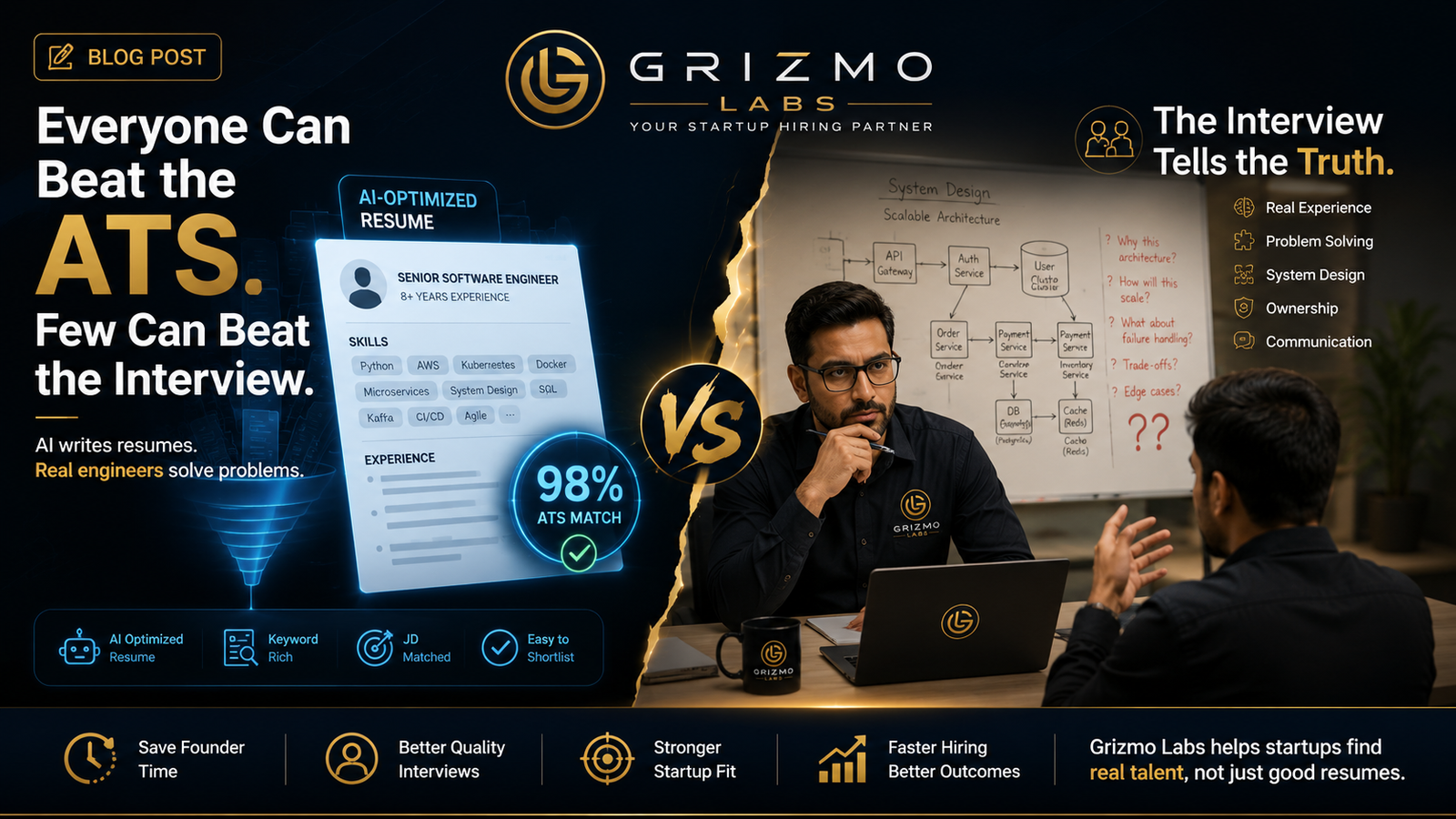
You bring the candidate in. Forty-five minutes later, you’re staring at your screen wondering how someone with “expert-level system design experience” couldn’t walk you through a basic architecture decision on a whiteboard.
If that scenario feels familiar, you’re not imagining things, and you’re not alone.
What’s Actually Happening
Most candidates today aren’t writing their resumes from scratch anymore. They’re running them through ChatGPT, Claude, Resume Worded, Teal, and a growing list of AI-powered resume optimizers built specifically to beat applicant tracking systems.
These tools are good at what they do. That’s exactly the problem.
- Resumes are now keyword-optimized by default. If a job description mentions “distributed systems” or “CI/CD pipelines,” the resume mentions them too — regardless of how deep that experience actually goes.
- Every profile looks impressive. Vague accomplishments get rewritten into confident, quantified achievements. “Worked on backend improvements” becomes “Led backend optimization initiative, improving system performance by 40%.”
- Technical skills appear stronger than they really are. AI tools are excellent at translating a candidate’s loosely-remembered experience into precise, technically fluent language — fluency the candidate may not actually have.
- Recruiters and founders are drowning in “qualified” resumes. The volume of resumes that clear an initial keyword or ATS screen has gone up. The signal-to-noise ratio has not improved. If anything, it’s gotten worse.
None of this makes candidates dishonest. Most people using these tools genuinely believe they’re just presenting themselves well — and in a market where everyone else is doing the same thing, not using them can feel like showing up underdressed. But the effect on hiring managers is the same either way: the paper no longer tells you the truth.
Definition — Resume inflation: Resume inflation is when AI writing tools translate a candidate’s actual experience into more confident, technically precise, or quantified language than the underlying experience supports, making the candidate appear more qualified on paper than they are in practice.
The Real Cost: Your Time
Here’s what this actually costs a founder or engineering leader.
You spend somewhere between 45 and 90 minutes interviewing a candidate who looked like a near-perfect match on paper. You ask them to explain a decision they claimed to have made. You ask a follow-up. The answers get vaguer, not more specific. By the end of the call, it’s clear the resume described someone more senior, more hands-on, or more technically deep than the person actually sitting in front of you.
Multiply that by every strong-looking resume in your pipeline this month, and the real cost isn’t just wasted interview time. It’s:
- Delayed hiring timelines, because your “qualified” pipeline keeps producing false positives.
- Interview fatigue for your team, who start dreading a process that feels like it isn’t working.
- Opportunity cost, because every hour spent on a mismatched candidate is an hour not spent finding the right one.
- Erosion of confidence in your own screening process — which is often the most dangerous cost of all, because it leads founders to either over-correct with excessive assessments or under-correct by trusting resumes less than they should, even for genuinely strong candidates.
For an early-stage startup, where a single engineering hire can shape a product roadmap for the next year, this isn’t a minor inefficiency. It’s a real drag on how fast you can build.
Why Resumes Alone Were Never Going to Survive This
It’s worth being honest about something: resumes were already an imperfect signal before AI writing tools existed. What’s changed is that the gap between “resume quality” and “actual capability” has widened, and it’s widened fast.
A resume is a candidate’s description of their work. It was never a demonstration of it. AI tools have simply made that description far more persuasive — sometimes more persuasive than the underlying reality supports.
That means the old approach of leaning heavily on resume screening as a filter is becoming less reliable by the month. Founders who keep treating an AI-polished resume the way they’d have treated a resume five years ago are going to keep burning interview slots on mismatches.
What Actually Works Now
This doesn’t mean hiring has to get slower or more painful. It means the point where real evaluation happens needs to move earlier, and needs to test something a resume can’t fake.
A few shifts I’d encourage founders and engineering leaders to make:
1. Screen for demonstrated work, not described work. Ask candidates to walk through a real project in detail — not to recite what’s on their resume, but to explain decisions, trade-offs, and what they’d do differently. AI can help someone describe a system. It can’t help them defend design choices they never actually made.
2. Use short, focused technical exercises before the full interview loop. A well-designed 30-45 minute technical task, scoped to the actual role, filters out resume-inflation far faster than another round of conversation. It doesn’t need to be a marathon take-home — it needs to be specific enough that only real experience gets you through it.
3. Ask “how,” not just “what.” “What did you build?” invites a rehearsed, resume-shaped answer. “How did you decide between these two approaches, and what broke when you got it wrong?” invites something much harder to fake.
4. Weight consistency over polish. A candidate whose answers are consistent, specific, and occasionally uncertain in believable ways is often a stronger signal than one whose answers are uniformly smooth. Real experience has texture. Overly polished narratives often don’t.
5. Build screening that a resume optimizer can’t route around. The more your evaluation depends on how something is written, the more vulnerable it is to these tools. The more it depends on how someone actually thinks and works, the less vulnerable it becomes.
How Grizmo Labs Screens for This
This is a big part of why we don’t treat resume review as a real filter at Grizmo Labs — it’s a starting point, not a decision point.
Before we ever put a candidate in front of a founder, we go past the resume: understanding the actual depth behind the bullet points, probing technical claims directly, and making sure the person we’re presenting can genuinely do what their profile says they can do. Our job is to absorb the noise created by resume-optimization tools so founders don’t have to spend their limited interview hours filtering it out themselves.
It’s also why we think of ourselves as hiring consultants rather than resume brokers. A resume forwarded without that layer of verification isn’t saving a founder time — it’s just moving the filtering problem downstream, into their calendar.
The Bigger Shift
AI resume tools aren’t going away, and they’re not inherently a bad thing — they help candidates communicate more clearly, and they lower the barrier for people who are strong at the job but weak at self-marketing. That’s a real, positive side effect.
But it does mean the burden of evaluation is shifting. Founders and hiring teams can’t outsource judgment to a resume screen anymore, if they ever really could. The teams that adapt their screening to test real signal — not polished language — are going to move faster and hire better than the ones still treating a great-looking resume as a great-looking candidate.
Key Takeaways
- AI resume optimizers have made nearly every resume look strong, which has weakened resumes as a screening signal rather than strengthened it.
- The real cost isn’t just bad hires — it’s the compounding time lost interviewing candidates who can’t back up their profile.
- Resumes describe work; they don’t demonstrate it. Screening needs to test demonstration, not description.
- Short, role-specific technical exercises and “how did you decide” questions are harder for AI-polished narratives to survive than open-ended conversation.
- Startups that build screening around verified depth, not resume polish, protect their most limited resource: founder and engineering-leader time.
Frequently Asked Questions
1. Are AI resume tools making candidates dishonest? Not typically. Most candidates are using these tools to present real experience more clearly, but the tools can also make thin experience sound stronger than it is — intentionally or not.
2. Should startups stop using resumes as a first filter? Not entirely, but resumes should be treated as a starting point for further verification, not as a reliable signal of actual capability on their own.
3. What’s the fastest way to catch resume-inflation before a full interview loop? A short, role-specific technical exercise or a structured “walk me through a real decision” conversation tends to surface gaps much faster than another round of open-ended discussion.
4. Does this problem apply more to technical roles than other roles? Technical roles are especially affected because claims are specific and verifiable, but the same resume-inflation pattern shows up across most functions where AI writing tools are used.
5. How does Grizmo Labs handle this in its own screening process? Grizmo Labs verifies the depth behind a candidate’s claims before presenting them to a founder, so the resume is treated as a starting point rather than the basis for a hiring decision.
6. How can a startup design a technical exercise that’s fair but still filters effectively? Keep it short, scope it tightly to the actual work the role requires, and focus on decisions and trade-offs rather than a long build — the goal is depth of thinking, not hours of unpaid labor.
7. Are ATS keyword filters still useful if resumes are AI-optimized? They’re still useful for basic eligibility checks, but they shouldn’t be treated as a quality signal anymore, since AI tools are specifically designed to satisfy them.
8. What’s the difference between resume screening and technical screening? Resume screening evaluates how a candidate describes their experience; technical screening evaluates whether they can actually perform at the level that description implies.
Internal Linking Suggestions
- Link to “Building Grizmo Labs: From Recruiter to Startup Hiring Partner”
- Link to a Grizmo Labs “How We Screen Candidates” or process page
- Link to a future post on “How to Design a Technical Exercise Candidates Won’t Game”
- Link to a Grizmo Labs “Work With Us”
Frequently Asked Questions
Q: Are AI-optimized resumes actually bad?
A: They’re not inherently bad—they’re just insufficient as the primary hiring signal. AI-optimized resumes all look similarly qualified, which actually makes it harder to differentiate real experience from polished descriptions. They’re best used as a starting point, not a decision-maker.
Q: Should I ban AI-written resume submissions?
A: No. Banning AI resumes is impractical and punishes legitimate candidates. Instead, treat all resumes as a starting signal and focus on evaluations that can’t be faked: technical exercises, real project discussions, and demonstrated decision-making.
Q: What’s the fastest way to spot resume inflation?
A: Ask candidates to walk you through a real decision or trade-off they made. Resume-polished narratives break down quickly when asked “how” and “why,” not just “what.”
Q: How should technical hiring change given AI-optimized resumes?
A: Move the evaluation point earlier. Use short, role-specific technical exercises or portfolio reviews before (or instead of) another round of resume-based discussion to save time and get more signal.
Q: Are skills-based resumes better than achievement-based resumes?
A: When resumes are AI-optimized, both formats suffer equally. The real differentiator is demonstrated work—actual projects, decisions made, and outcomes. Focus there instead of fighting over resume format.
- Link to a post on skills-based hiring vs. pedigree-based hiring, if published
External Authoritative Reference Suggestions
(To be selected and verified by the Grizmo Labs team from current, reputable sources before publishing — e.g., reporting on AI resume-writing adoption from outlets like LinkedIn’s Talent Solutions blog, SHRM, or Harvard Business Review, and any well-established data on applicant tracking system usage.)
AEO (Answer Engine Optimization) Recommendations
- Lead with a direct, self-contained answer. The “Quick answer” callout at the top states the core claim and the core fix in two sentences, written so it can be lifted and cited without needing the rest of the article for context.
- Define key terms explicitly. The “Resume inflation” definition is phrased as a standalone, quotable definition — the format answer engines tend to prefer for glossary-style extraction.
- Keep FAQ answers self-contained. Each FAQ answer fully answers its question in 1–3 sentences without depending on the surrounding article, so it can be extracted independently.
- Use question-phrased subheadings where natural. Consider testing variants like “Why do resumes all look the same now?” or “How should startups screen candidates in the AI era?” for H2s in future revisions — question-form headers are more likely to match conversational queries fed to answer engines.
- Keep the byline and entity signals consistent. Repeating “Gaurav Raj Sompura, Founder & CEO, Grizmo Labs” alongside
PersonandOrganizationschema helps answer engines correctly attribute the source when citing this content. - Avoid burying the recommendation. Practical, numbered advice (as in “What Actually Works Now”) is more likely to be extracted intact than advice woven into narrative paragraphs.
- Consider publishing a companion
llms.txtat the site root, listing this post and other key resources, if the Grizmo Labs site wants to explicitly guide AI crawlers to its most citation-worthy pages.