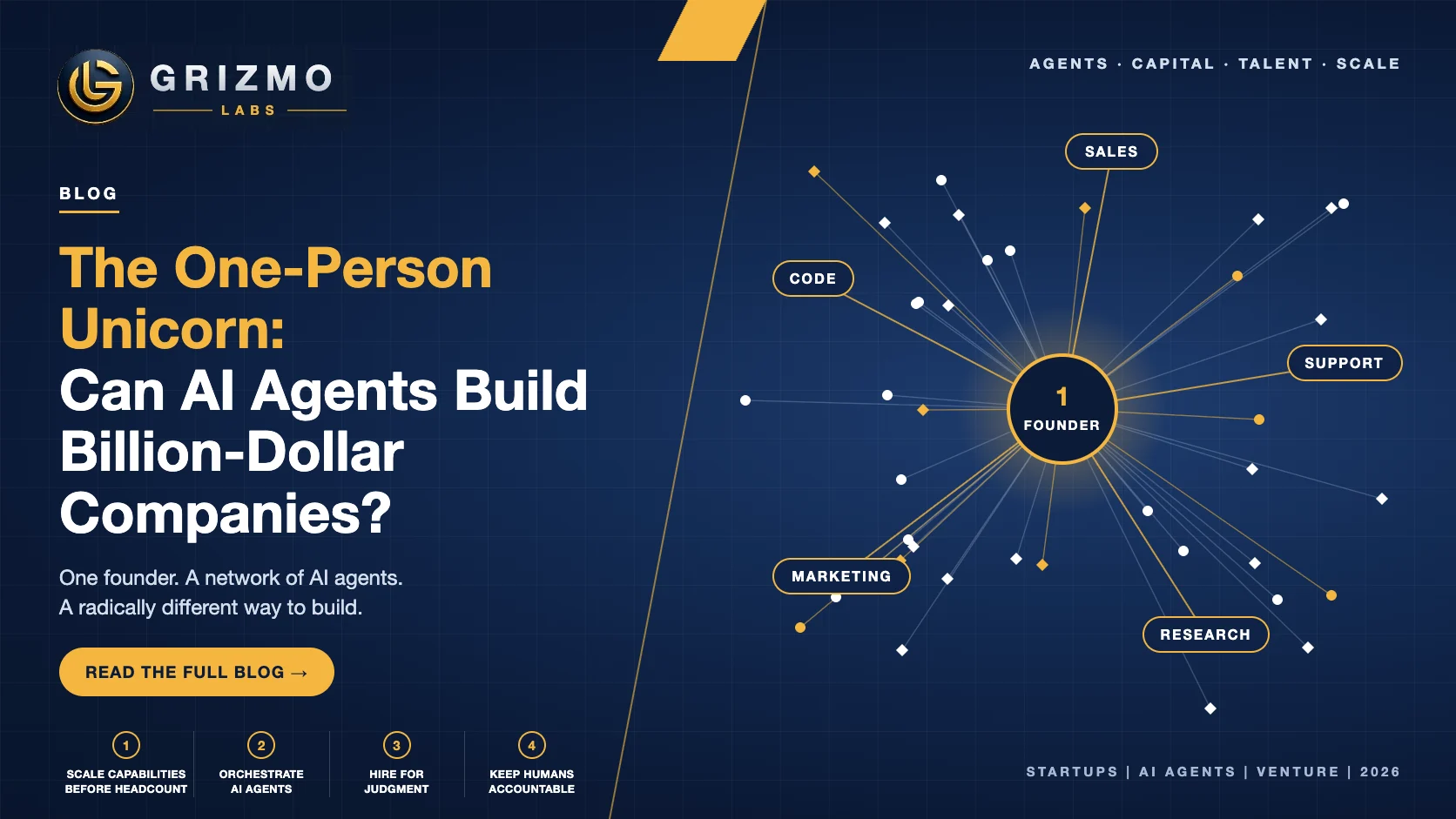
A one-person unicorn is a startup valued at $1 billion or more that is built and run by a single founder, who relies on AI agents for work that once needed large teams. For decades, startups followed a familiar formula: raise capital, hire talent, build teams and scale. Now, AI agents can write code, research markets, support customers and run campaigns.
Moreover, the idea is no longer fringe. At the launch of Claude 4 in May 2025, Anthropic CEO Dario Amodei predicted the first one-person billion-dollar company would arrive in 2026. Meanwhile, Carta data shows that solo founders started 36.3% of new startups in the first half of 2025, up from 23.7% in 2019.
So what happens when a founder can do with five people what once took fifty? In this guide, we look at how the one-person unicorn could change how startups are built, funded and staffed. We also cover what it means for hiring founding engineers.
Key Takeaways
- Solo founding is rising fast. Solo founders started 36.3% of new startups in H1 2025, up from 23.7% in 2019 (Carta).
- AI agents shift growth from headcount to capability. Coding, sales, marketing, support and research agents let small teams do more.
- A one-person unicorn is possible, but not yet a blueprint. The nearer shift is the 10-person company that competes with a 100-person rival.
- VCs still judge fundamentals. Retention, margins, distribution and defensibility matter more than team size.
- Exceptional talent becomes more valuable. As execution gets automated, technical judgment becomes the differentiator.
In This Article
- What Is a One-Person Unicorn?
- From Headcount-Driven Growth to Intelligence-Driven Growth
- The New Startup Operating Model: Humans + Agents
- Can a One-Person Unicorn Really Reach a $1 Billion Valuation?
- How the One-Person Unicorn Model Changes Venture Capital
- The Talent Paradox: Why a One-Person Unicorn Still Needs Great Engineers
- What AI Agents Still Cannot Reliably Replace
- The Rise of the AI-Native Founding Team
- The Next Unicorn Might Be Tiny
- Frequently Asked Questions
What Is a One-Person Unicorn?
A one-person unicorn is a company that reaches a $1 billion valuation with one human operator, or very close to it. Instead of departments, the founder directs a network of specialized AI agents. However, the founder still owns strategy, judgment and accountability.
Early signals already exist. For example, Wix bought Base44 for $80 million in cash in June 2025. Solo founder Maor Shlomo had built the six-month-old company with a team of just eight people. That is far from $1 billion, yet it shows how much value a tiny AI-native team can create.
From Headcount-Driven Growth to Intelligence-Driven Growth
Traditionally, scaling a technology company meant scaling its workforce. For instance, more customers required more support reps. Likewise, more features required more engineers, and more leads required more salespeople.
AI-native startups are breaking that link. Imagine a company where specialized agents handle the repeatable work:
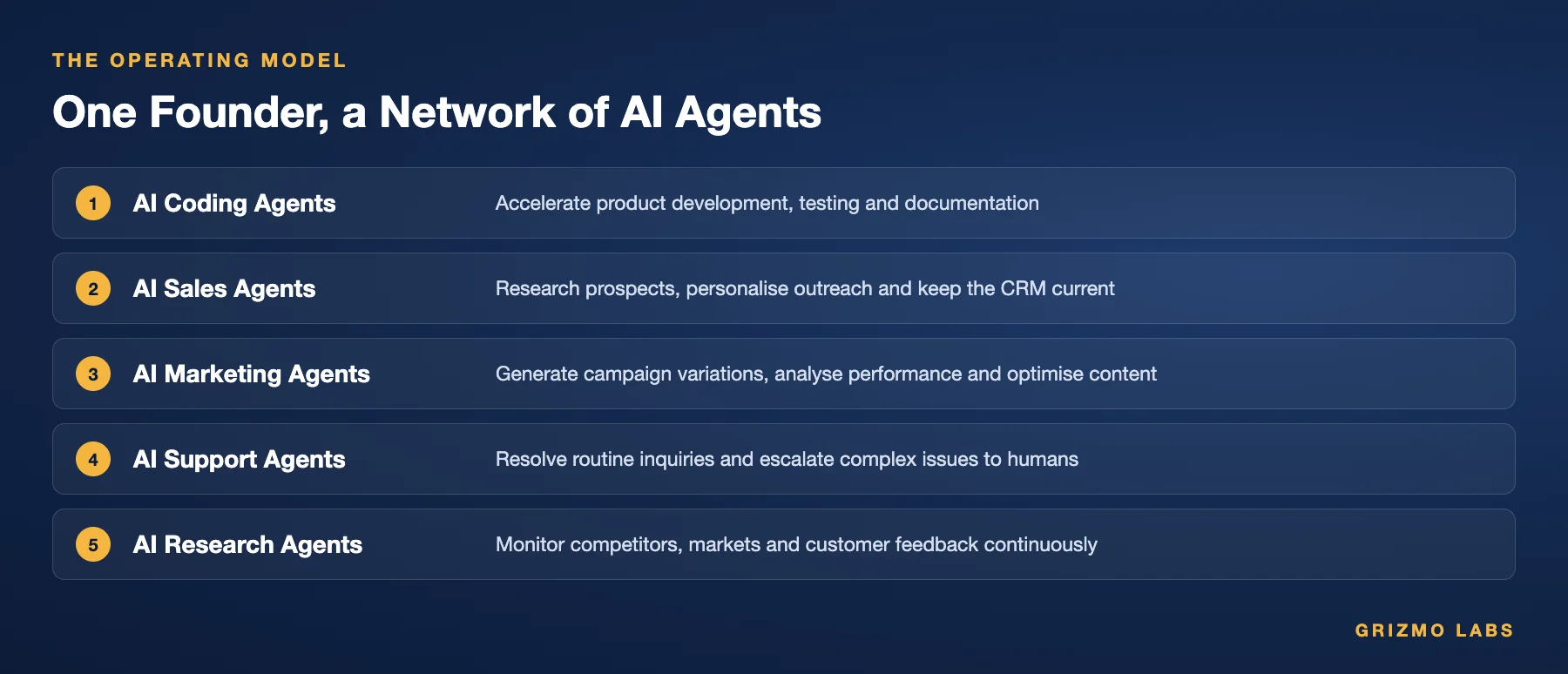
- AI coding agents speed up product development, testing and documentation.
- AI sales agents research prospects, personalize outreach and keep CRM records current.
- AI marketing agents generate campaign variations, analyze performance and optimize content.
- AI support agents resolve routine questions and escalate complex issues.
- AI research agents monitor competitors, markets and customer feedback.
As a result, founders orchestrate agents instead of hiring a team for every function. The advantage shifts from how many people a startup employs to how well those people coordinate intelligence.
Still, automating tasks is not the same as running a reliable business. Agentic systems need supervision, integration, security and accountability.
The New Startup Operating Model: Humans + Agents
To illustrate, consider two hypothetical early-stage SaaS companies chasing the same market:
| Startup A: Traditional | Startup B: AI-Native | |
|---|---|---|
| Core team | 30 people | 5 people |
| Structure | Separate engineering, product, marketing, sales, success and ops teams | Small core team plus specialized AI agents |
| Repeatable work | Done by people | Development, research, support and ops handled by agents |
| Fixed costs | High | Lower, with new costs for models, infrastructure, QA and oversight |
Startup B could iterate faster and run leaner. That outcome is not guaranteed, though. Agent infrastructure, model usage, quality assurance, compliance and human oversight all carry real costs.
In other words, the opportunity is not replacing employees with software. Instead, it is redesigning workflows so small teams deliver outsized value. That leads to a new operating principle:
Scale capabilities before scaling headcount.
Can a One-Person Unicorn Really Reach a $1 Billion Valuation?
In theory, yes. A billion-dollar valuation doesn’t require a billion dollars in revenue or a particular headcount. Rather, it reflects what investors expect about future growth, economics, defensibility and risk.
Specifically, a solo founder could build a highly valuable software business by combining:
- A globally accessible product
- AI-assisted development and distribution
- Recurring revenue with low marginal delivery costs
- Strong retention and customer demand
- Proprietary technology, data or distribution advantages
But there’s an important distinction. Building a product with one person is not the same as building an enduring billion-dollar company with one person. Enterprise sales, security incidents, legal duties, partnerships and resilience all get harder to manage alone.
Therefore, for now, the one-person unicorn is a compelling possibility, not an established blueprint. The nearer change may be the 10-person company that competes with a 100-person rival. Even that would be a major shift in startup economics.
How the One-Person Unicorn Model Changes Venture Capital
For investors, therefore, AI-native companies raise a big question. What if startups could reach meaningful revenue with far less capital? The implications include:
- Greater capital efficiency. Smaller teams cut fixed costs and extend runway.
- Faster experimentation. AI-assisted development allows more product iterations before large bets.
- Higher revenue per employee. Automation lets revenue grow faster than headcount.
- New investment risks. Lower barriers to building increase competition and make features easier to copy.
Funding has not fully caught up yet. According to Carta, solo founders made up 30% of startups founded in 2024 but received only 14.7% of cash raised in priced equity rounds.
Even so, VCs should not confuse a small team with a strong business. Retention, gross margins, distribution, defensibility and durable growth still decide outcomes. In the end, AI can make building software cheaper. But it cannot automatically make customers care.
The Talent Paradox: Why a One-Person Unicorn Still Needs Great Engineers
If AI agents handle more routine engineering, will startups need fewer talented engineers? Possibly fewer people for some tasks. However, they will not need less engineering expertise.
In fact, technical judgment becomes more valuable as execution is automated. After all, a founder using AI coding agents still needs someone who understands architecture, performance, security and reliability. For example, an AI-generated app may shine in a demo. Yet making it reliable for millions of users is a different challenge.
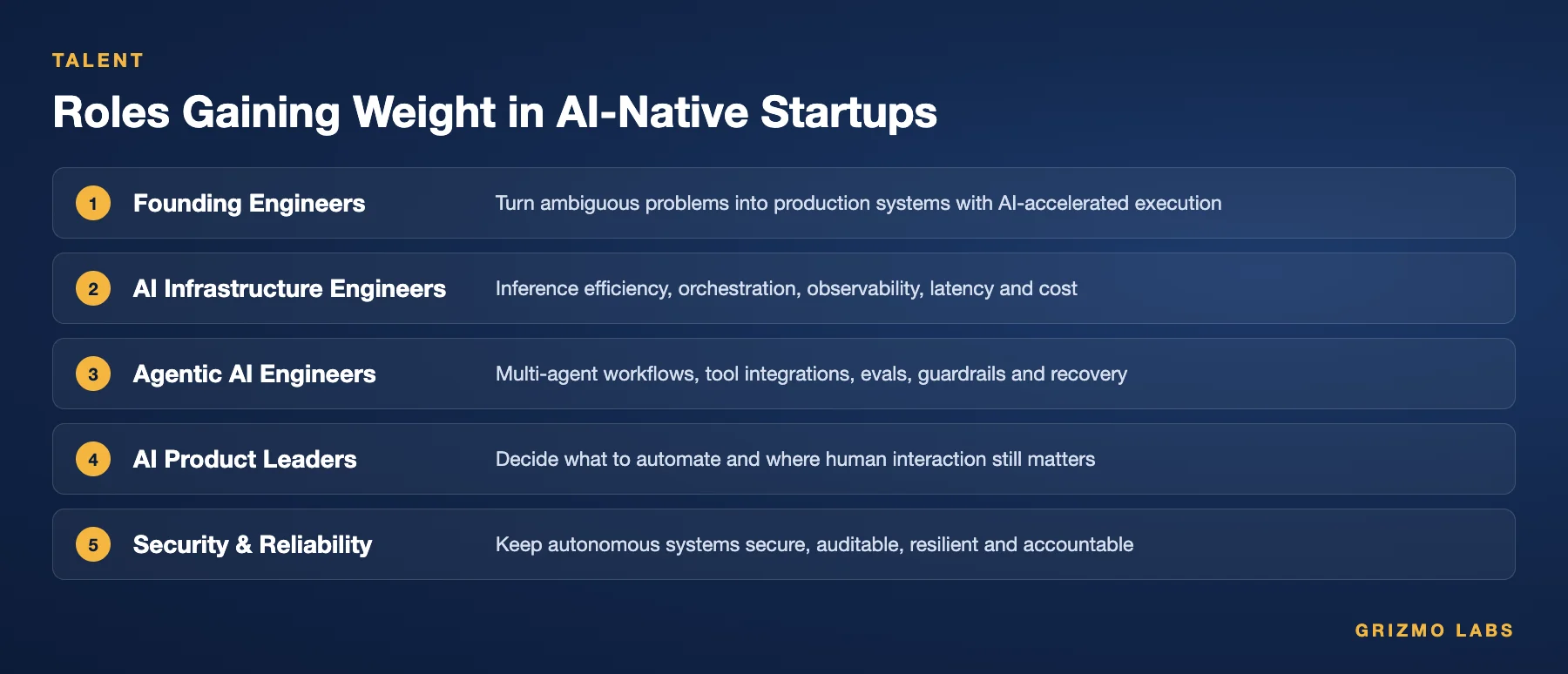
The next generation of high-impact startup talent will likely include:
- Founding Engineers: builders who turn ambiguous problems into production systems, pairing architectural judgment with AI-accelerated execution.
- AI Infrastructure Engineers: specialists in inference efficiency, orchestration, observability, latency and cost.
- Agentic AI Engineers: designers of multi-agent workflows, tool integrations, evaluations, guardrails and recovery.
- AI Product Leaders: people who know what to automate and where human interaction still matters.
- Security and Reliability Engineers: experts who keep autonomous systems secure, auditable and resilient.
Ultimately, the future may not reward the largest engineering teams. It may reward teams with the highest concentration of exceptional talent. That is why hiring AI and LLM engineers is now a strategic decision, not an operational one.
What AI Agents Still Cannot Reliably Replace
Despite rapid progress, however, several capabilities remain hard to delegate fully, even in a one-person unicorn:

- Strategic judgment: deciding which markets to enter, which customers to serve and which opportunities to reject.
- Founder conviction: owning hard decisions when information is incomplete.
- Trust and relationships: building real bonds with customers, investors and employees.
- Original problem discovery: finding unmet needs that existing data does not reveal.
- Accountability: owning the consequences when automated decisions fail.
- Leadership: inspiring people, managing conflict and shaping culture.
In short, AI agents can support these functions, but support is not replacement. The best AI-native companies will not remove humans from decisions. Instead, they will get very good at deciding where human intelligence matters most.
The Rise of the AI-Native Founding Team
For founders, the central question is changing. Instead of asking how many engineers a product needs, the better question is:
“What is the smallest exceptional team that can build, validate and reliably operate this product with AI?”
As a result, that changes first-hire strategy. One outstanding founding engineer with systems depth, product intuition and AI-native skills may be worth more than several engineers doing routine work.
The goal isn’t extreme headcount reduction, though. It is finding the capabilities that create a durable competitive edge. As we explored in The AI-Native CTO: Engineering Leadership in 2027, judgment is becoming the product.
The Grizmo Labs Perspective
At Grizmo Labs, we believe founding-team design is now one of the most important strategic choices an early-stage company makes. The first few technical hires shape how fast a product is built. In addition, they shape how well the whole organization uses AI.
That is why hiring is shifting from maximizing headcount to maximizing technical capability, ownership and impact. Smaller teams may build the next generation of unicorns. Consequently, the quality of those teams will matter more than ever.
Conclusion: The Next Unicorn Might Be Tiny
The one-person unicorn is more than a provocative headline. Above all, it signals a broader shift in how economic value gets created. We are moving toward a world where:
- Company size becomes a weaker proxy for capability.
- AI agents handle more repeatable execution.
- Technical judgment becomes a critical differentiator.
- Capital efficiency shapes startup strategy.
- Small, highly capable teams compete with far larger organizations.
Billion-dollar outcomes will still demand more than automation: customer obsession, differentiated products, reliable systems, strong distribution and exceptional leadership. The future of startups isn’t humanless. It’s human-leveraged.
Perhaps the most interesting question is not whether one person can build a unicorn. Rather, it is this: what becomes possible when one exceptional person can operate with the capabilities of an entire company?
Frequently Asked Questions
What is a one-person unicorn?
A one-person unicorn is a startup valued at $1 billion or more that is built and run by a single founder. The founder uses AI agents for engineering, sales, marketing, support and research work that once needed large teams.
Has a one-person unicorn been built yet?
Not as a widely confirmed case. Anthropic CEO Dario Amodei predicted the first one could appear in 2026. The closest public example is Base44, a solo-founded startup that Wix bought for $80 million in 2025.
Can AI agents really run a billion-dollar company?
AI agents can run much of the repeatable execution. However, strategy, trust, accountability, security and leadership still need human judgment, especially as a company grows.
How do AI agents change venture capital?
They can improve capital efficiency, speed up experimentation and raise revenue per employee. They also lower barriers to entry, which increases competition and makes software features easier to copy.
Which roles matter most in an AI-native startup?
Founding engineers, AI infrastructure engineers, agentic AI engineers, AI product leaders, and security and reliability engineers matter most. These roles combine technical judgment with the ability to direct AI systems.
Join the Conversation
- Founders: Would you build your next startup with five exceptional engineers and AI agents instead of a 30-person team?
- VCs: Will revenue per employee and AI leverage become key signals of startup potential?
- Engineering leaders: Which technical responsibilities should never be fully handed to autonomous agents?
Sources and Methodology
This article combines Grizmo Labs’ view of the startup hiring market with the public sources below. Figures are as reported by each source at the time of publication.
- Carta, Solo Founders Report 2025: share of new startups with solo founders and their share of priced-round funding.
- TechCrunch, June 2025: Wix acquisition of Base44 for $80 million.
- OfficeChai, May 2025: Dario Amodei on the first one-person billion-dollar company.
Build Your AI-Native Founding Team with Grizmo Labs
The next generation of unicorns may be built by smaller teams, so every early hire counts. Grizmo Labs helps ambitious startups find the founding engineers and AI-native builders who turn breakthrough ideas into scalable businesses.
Hiring your first engineers or a technical leader? We recruit founding engineers, AI and LLM engineers and senior engineering leadership.