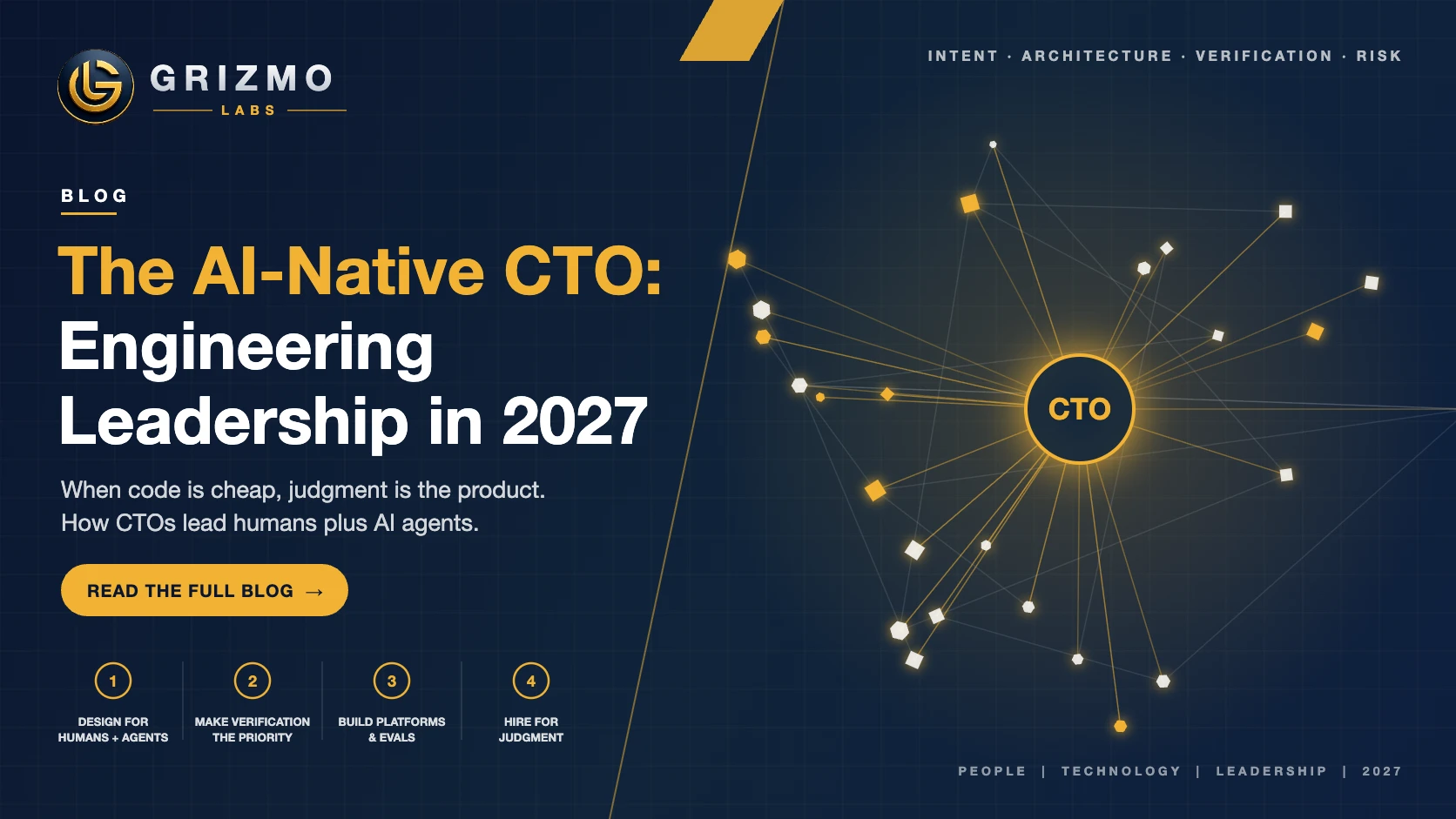
An AI-native CTO is a technology leader who designs the engineering organisation on the assumption that AI agents handle much of the implementation, while humans own intent, architecture, verification and risk. In 2027, that shift turns the CTO role from scaling headcount into scaling judgment.
Why does that matter? In July 2025, METR ran a randomised trial with 16 experienced open-source developers. With AI tools, they finished real tasks about 19% slower. Yet afterwards, the same developers estimated AI had made them about 20% faster. Six months later, METR said it had to redesign the study because too many developers refused to work without AI at all.
Together, those two facts define the CTO’s problem for 2027. AI has changed how engineers work faster than anyone can measure what it changes. This guide explains what the AI-native CTO does differently, the technical stack behind the role, and what it means for hiring technology leaders.
Key Takeaways
- AI use in engineering is near-universal: 90% of technology professionals use AI at work (Google DORA 2025).
- Productivity gains are real but uneven. Self-reported gains run well ahead of controlled measurement.
- AI now lifts delivery throughput but still correlates with lower stability, so verification is the new bottleneck.
- The AI-native CTO designs for humans plus agents: context, orchestration, verification, evaluation and security.
- The scarcest asset in 2027 is engineering judgment. Hiring that tests only coding output will miss it.
In This Article
- What Is an AI-Native CTO?
- Why the AI-Native CTO Matters Now
- Where AI-Native Engineering Is Showing Up
- The AI-Native CTO Technical Stack
- Traditional CTO vs AI-Native CTO
- How AI Changes Startup Economics
- Engineering Talent Implications for the AI-Native CTO
- The Grizmo Labs Perspective
- Conclusion: Judgment Is the Product
- Frequently Asked Questions
What Is an AI-Native CTO?
An AI-native CTO is not a CTO who bought AI coding assistant seats. Instead, it is a leader who redesigns how software gets built when agents can write much of the code. In practice, the role concentrates on four areas of ownership:

- Intent: Turning product goals into clear specifications that humans and agents can execute.
- Architecture: Setting system boundaries, interfaces and standards that keep agent output coherent.
- Verification: Building the tests, reviews and evals that prove output is correct.
- Risk: Governing agent permissions, security, compliance and provenance.
The shift is already visible. Anthropic’s internal study (December 2025) found its staff used Claude in about 60% of their work, up from 28% a year earlier. Engineers described their jobs moving toward reviewing and directing agent output. However, Anthropic’s 2026 Agentic Coding Trends Report notes developers can “fully delegate” only 0–20% of tasks. So the job is not replacing engineers with agents. It is redesigning the system around a new bottleneck.
Why the AI-Native CTO Matters Now
Adoption is no longer the question. Google’s 2025 DORA report found 90% of nearly 5,000 technology professionals use AI at work. Similarly, McKinsey’s State of AI 2026 found 40% of large organisations are scaling AI agents, up from 27% a year before.
The capability curve is also steep. METR estimates the length of task frontier agents can complete has doubled roughly every seven months since 2019, and faster for recent models. That is a measured trend, not a promise that it continues.
But the returns are uneven. Only 6% of McKinsey’s respondents qualify as AI high performers, unchanged from 2025. Meanwhile, Gartner predicts over 40% of agentic AI projects will be cancelled by the end of 2027. And DORA found AI adoption now improves delivery throughput, yet still correlates with lower delivery stability.
Speed without stability is not velocity. It is debt with a better dashboard.
Where AI-Native Engineering Is Showing Up
AI-native engineering is spreading across sectors, but the constraint looks different in each one:
- Startups: Small teams are shipping what once needed a department. As a result, the constraint moves from engineering capacity to product judgment and distribution.
- Enterprise software: McKinsey found 32% of organisations skipped buying a software product because they built it in-house with agentic coding tools. Build-vs-buy is being re-litigated, as we explored in From SaaS to GaaS.
- Fintech: Anthropic cites CRED, the Bengaluru fintech, doubling execution speed while holding quality standards. In regulated domains, the review and audit trail is the product.
- Healthcare: Agents can draft integrations and documentation. However, every output touching patient data needs provenance and human sign-off.
- Developer tools and AI infrastructure: The fastest-growing surface is the plumbing: evaluation harnesses, agent orchestration, sandboxes, and protocols like MCP that connect agents to tools and data.
The AI-Native CTO Technical Stack
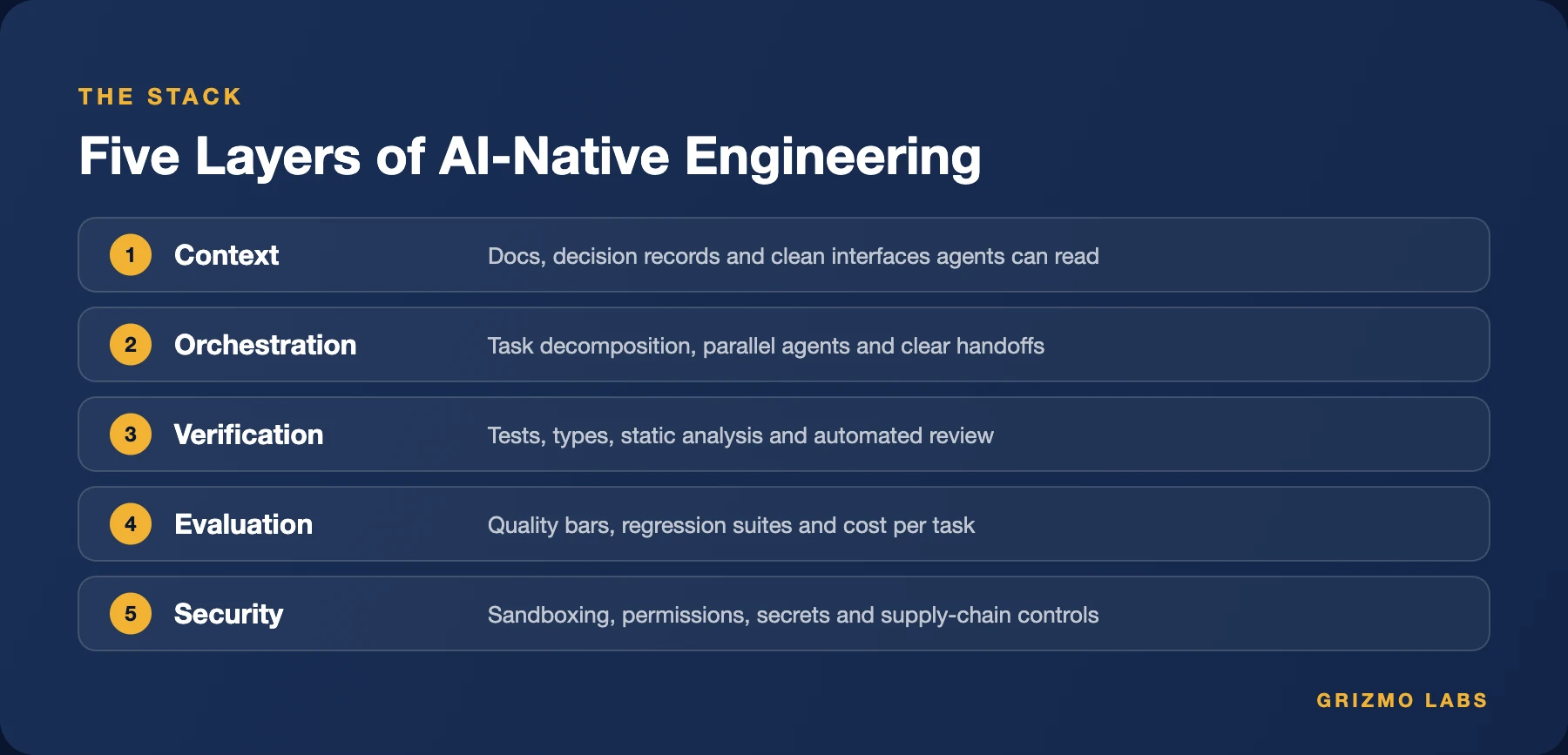
For the AI-native CTO, the 2027 architecture agenda has five layers:
1. Context
Agents are only as good as what they can see. Repository documentation, architecture decision records and clean interfaces are now production inputs, not hygiene.
2. Orchestration
Teams are moving from single assistants to coordinated agents working in parallel. That needs task decomposition, isolation and clear handoffs.
3. Verification
When generation is cheap, tests, type systems, static analysis and automated review become the real throughput limit. DORA’s data agrees: strong testing and fast feedback loops decide whether AI helps or hurts.
4. Evaluation
Every AI feature and internal agent needs evals: measurable quality bars, regression suites and cost per task.
5. Security
Agents with repository and tool access widen the attack surface. Therefore permissions, sandboxing, secrets handling and supply-chain controls belong in the design, not the post-mortem.
Platform engineering is quietly becoming AI strategy. DORA found 90% of organisations run at least one internal platform, and platform quality correlates with getting value from AI. For more on how delivery itself is changing, see why companies are moving to an agentic SDLC.
Traditional CTO vs AI-Native CTO
The table below summarises how the role is shifting. It describes a direction of travel, not a finished state.
| Dimension | Traditional CTO | AI-Native CTO |
|---|---|---|
| Measure of scale | Headcount and hiring plans | Reliable output per engineer, humans plus agents |
| Core bottleneck | Writing code | Specifying, verifying and reviewing code |
| Key investments | Tooling and team growth | Context, platforms, test suites and evals |
| Risk focus | Uptime and security | Agent permissions, provenance and supply chain |
| Talent strategy | Hire for coding output | Hire for judgment, keep a junior pipeline |
How AI Changes Startup Economics
Three economics change at once:
- Cost of experiments falls. Anthropic staff estimated 27% of their AI-assisted work would not have happened otherwise. Cheap prototypes mean more bets per quarter.
- Headcount stops being the proxy for ambition. Boards will ask what a team ships per engineer, and how reliably, rather than how many engineers it has.
- Moats shift. If competitors can rebuild your feature set quickly, advantage moves to proprietary data, distribution, trust and the speed of the learning loop.
The risk is the flip side. McKinsey found 39% of respondents expect AI to reduce headcount next year, but only 14% saw an AI-linked decline last year. In other words, many leaders are planning around savings they have not yet measured.
Engineering Talent Implications for the AI-Native CTO
The roles gaining weight under an AI-native engineering model are clear:

- AI engineers who combine software engineering, data and model skills. Gartner flagged this hybrid in 2024, predicting 80% of the engineering workforce will need to upskill through 2027 (see AI engineer vs ML engineer).
- Agent and platform engineers who build the orchestration, sandboxes and internal tooling agents run on.
- Evaluation and reliability engineers who define what “good” looks like and prove it.
- Staff and principal engineers who set architecture and review at scale. Their leverage grows when every engineer directs several agents.
Consequently, the skills that matter shift from typing speed to decomposition, specification writing, systems thinking and sceptical review.
The uncomfortable part is the entry level. Stanford’s Digital Economy Lab found employment for 22–25-year-olds in the most AI-exposed occupations, including software development, fell about 16% relative to peers by October 2025. The authors stress AI is one cause among several. Still, Anthropic’s engineers named a “paradox of supervision”: overseeing AI needs the very skills that atrophy if you never write code.
A company that stops hiring juniors is eating its future seniors.
The Grizmo Labs Perspective
We spend our days on engineering leadership and AI talent searches for startups and scale-ups. The brief we receive has changed.
Founders used to ask for a CTO who could build a team of 30. Increasingly, they ask for an AI-native CTO who can get a team of eight, plus agents, to ship like 30, without breaking production or compliance.
That person is rare. The profile we see succeed combines three things:
- Hands-on credibility with agentic tooling. They have shipped with it, measured it and know where it fails.
- Systems discipline. They invest in testing, platforms and observability before scaling AI usage, because AI amplifies whatever is already there.
- Talent architecture. They design teams around senior judgment, keep an apprenticeship path for juniors, and hire for evaluation and platform skills early.
Our view: the scarcest asset in 2027 is not GPU capacity or model access. It is engineering judgment at the top of the org chart. Interview processes built to test coding output will miss it, so assess how candidates specify, decompose, review and decide. If you are weighing this hire now, read when is the right time to hire a CTO.
Conclusion: Judgment Is the Product
AI is making code abundant. Abundance moves value to whatever stays scarce: clear intent, sound architecture, trustworthy verification and people who know which problems are worth solving.
The AI-native CTO is not the one with the most agents. It is the one whose organisation still knows what is true about its own software.
Founders and CTOs: what is the first thing you would change in your engineering org if code really did become cheap tomorrow?
Frequently Asked Questions
What is an AI-native CTO?
A technology leader who designs the engineering organisation assuming AI agents handle much of implementation, while humans own intent, architecture, verification and risk.
Will AI agents replace software engineers by 2027?
Current evidence says no. Anthropic reports developers can fully delegate only 0–20% of tasks; roles are shifting toward review, orchestration and system design.
Does AI actually make developers more productive?
It depends. Surveys report large self-reported gains, while METR’s 2025 trial found a 19% slowdown for experienced developers on familiar codebases. Engineering maturity is the deciding factor.
What engineering roles are growing because of AI?
AI engineers, agent and platform engineers, evaluation and reliability engineers, and staff-level architects.
What should founders look for when hiring an AI-native CTO in 2027?
Hands-on experience shipping with agentic tools, discipline in testing and platforms, and a plan for developing talent, including junior engineers.
Sources and Methodology
Figures come from the primary sources below, accessed November 2026. Survey results are self-reported; predictions are labelled as such in the text.
- Google Cloud: 2025 DORA Report (23 Sep 2025)
- METR: Measuring the Impact of Early-2025 AI on Experienced Open-Source Developer Productivity (10 Jul 2025)
- METR: Developer productivity experiment update (24 Feb 2026)
- METR: Time Horizon 1.1 (29 Jan 2026)
- Anthropic: How AI is transforming work at Anthropic (2 Dec 2025)
- Anthropic: 2026 Agentic Coding Trends Report
- McKinsey: The State of AI 2026 (25 Aug 2026)
- Gartner: GenAI will require 80% of engineering workforce to upskill through 2027 (3 Oct 2024)
- SD Times: Gartner predicts over 40% of agentic AI projects will be canceled by end of 2027 (Jun 2025)
- Stanford Digital Economy Lab: Canaries, interest rates and timing (9 Feb 2026)
- Stanford HAI: 2026 AI Index Report (Apr 2026)
Hire Your AI-Native CTO with Grizmo Labs
The right technology leader shapes your architecture, engineering culture and how well your team turns AI into reliable output. A mis-hire at this level can cost a year.
Looking for a CTO, VP Engineering or Head of AI who can lead humans plus agents? Grizmo Labs runs specialist searches for founding engineers, AI and LLM engineers and engineering leadership.