Introduction: The SDLC Revolution is Happening Now
The software development landscape is rapidly evolving in 2026. Today, more companies are abandoning traditional software development lifecycle (SDLC) models in favor of an innovative approach: Agentic SDLC. This shift represents more than a simple technological upgrade—it’s a paradigm change in how development teams operate, collaborate, and deliver value.
Traditional SDLC methodologies have served as the foundation of software development for decades, following a standard sequence: requirements gathering, design, development, testing, and deployment. However, these methods are now viewed as slow and resource-intensive. In an era demanding rapid innovation, companies need faster solutions. Consequently, many organizations are seeking alternatives that can keep pace with market demands.
Significantly, Agentic SDLC introduces autonomous AI agents into the development process. These systems accomplish routine tasks and optimize workflows. More importantly, they work alongside human developers to deliver faster results without compromising quality. This guide explains why companies are making this shift, outlines the key benefits, and helps you determine if Agentic SDLC fits your team’s needs.
The software development landscape is undergoing a profound transformation in 2026. Today, enterprises across every industry are fundamentally rethinking how they build, deploy, and maintain software. The traditional Software Development Lifecycle (SDLC) model—once the gold standard for delivering reliable applications—is rapidly being supplemented, and in many cases, replaced by a revolutionary new approach: Agentic SDLC.
This isn’t just another incremental update to development methodologies. Agentic SDLC represents a paradigm shift in how software is conceived, built, and delivered. By integrating autonomous AI agents into every phase of the development process, companies are achieving unprecedented levels of productivity, quality, and speed. For technical leaders and CTOs evaluating their development strategies, understanding this shift has become essential.
What is Traditional SDLC and Why It’s Becoming Obsolete
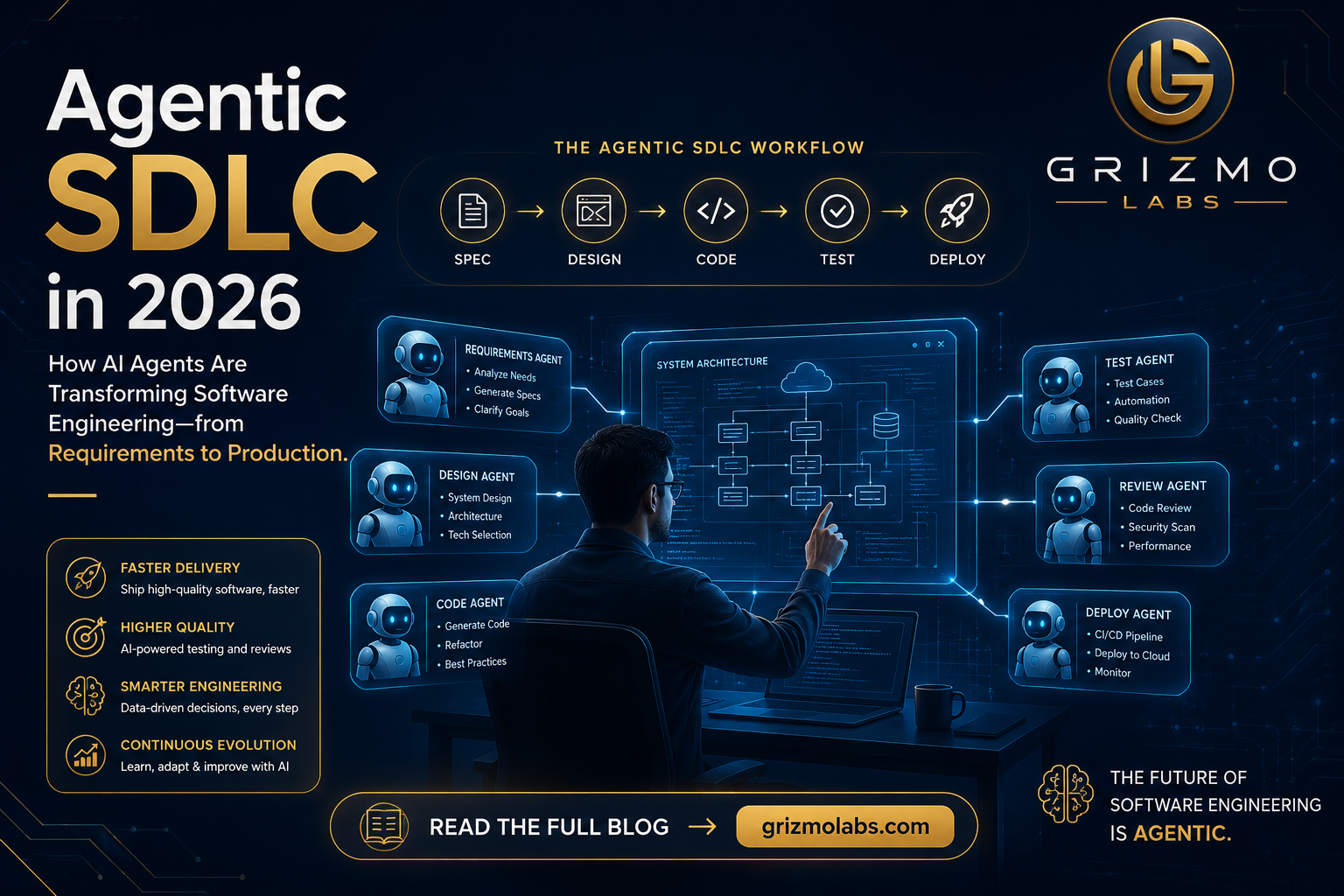
Traditional SDLC follows a well-established, sequential approach: Requirements Gathering → Design → Development → Testing → Deployment. For decades, this structured methodology provided organizations with predictability and control over their software projects.
However, the traditional model has several critical limitations in today’s fast-paced business environment:
Slow Time-to-Market: Traditional SDLC cycles often span months, with distinct phases that must complete before the next begins. Requirements changes midway through development require extensive rework, delaying releases.
High Resource Costs: These processes demand large teams across different specializations—business analysts, architects, developers, QA engineers—each working through lengthy review cycles. This overhead is expensive and often inefficient.
Rigidity in a Dynamic Market: Business requirements evolve constantly. Traditional SDLC’s phase-gate approach struggles with rapid pivots, leaving companies unable to respond quickly to competitive threats or market opportunities.
Quality and Burnout Issues: The pressure to meet deadlines in traditional models often leads to technical debt, inadequate testing, and developer burnout. Manual testing is time-consuming and error-prone.
In 2026, these limitations have become unacceptable. Companies competing in AI-driven markets, fintech, e-commerce, and SaaS require the ability to ship features weekly or even daily. Traditional SDLC simply cannot keep pace.
What is Agentic SDLC?
Agentic SDLC integrates autonomous AI agents into the development workflow, fundamentally changing how work is distributed and executed. These agents are intelligent systems trained to understand code, architecture, business requirements, and development best practices. They don’t replace developers—they augment and amplify human capabilities.
Key characteristics of Agentic SDLC include:
Autonomous Code Generation: AI agents can write, refactor, and optimize code at scale. They generate production-ready code based on specifications, significantly reducing the time developers spend on routine implementation.
Intelligent Testing and QA: Agents automatically generate comprehensive test cases, perform regression testing, and identify edge cases humans might miss. This dramatically improves code quality while reducing manual QA overhead.
Continuous Requirements Analysis: AI agents parse requirements documents, identify inconsistencies, and ask clarifying questions before development begins—preventing costly misunderstandings.
Automated Code Review and Optimization: Agents review code for adherence to standards, security vulnerabilities, performance issues, and architectural patterns, providing instant feedback without human review delays.
Context-Aware Development: Unlike traditional tools, Agentic SDLC systems maintain deep understanding of your entire codebase, architecture, and business context, enabling genuinely intelligent suggestions.
Key Differences Between Traditional and Agentic SDLC
Traditional SDLC focuses on sequential phases with manual processes at each stage. Agentic SDLC, by contrast, uses AI agents to automate and parallelize these workflows. Development cycles compress from months to days. Testing transforms from manual and scripted to automated and AI-generated. Code review shifts from human-intensive to real-time agent-powered feedback. Requirements become dynamic and adaptive rather than static and change-resistant. Teams become smaller and specialized, augmented by AI rather than scaling with headcount. Technical debt reduces significantly as quality is maintained at higher speeds. Scalability improves dramatically as output scales with computational resources rather than team size.
Why Companies Are Making the Switch
The business case for Agentic SDLC is compelling:
Accelerated Time-to-Market: Companies using Agentic SDLC report 50-70% reduction in development cycles. Features that once took 8 weeks can now ship in 2-3 weeks, with comparable or better quality.
Reduced Development Costs: While AI infrastructure requires investment, the reduction in developer hours, testing overhead, and rework makes projects significantly cheaper. Many companies report 30-40% cost savings within the first year.
Improved Code Quality: Automated testing and continuous agent-powered code review actually improve quality metrics. Security vulnerabilities are caught earlier, technical debt is minimized, and performance issues are identified proactively.
Talent Retention: Developers love Agentic SDLC. By eliminating tedious, repetitive work, developers focus on high-impact architectural decisions and creative problem-solving. This improves job satisfaction and reduces turnover.
Competitive Advantage: In markets where features and speed matter, Agentic SDLC is increasingly a competitive necessity. Companies that ship 2x faster with equal quality will outpace competitors still using traditional methods.
Scalability Without Headcount Growth: As your business grows, traditional SDLC requires proportional team growth. Agentic SDLC allows you to scale output without proportional headcount increases.
Real-World Implementation Examples
Leading tech companies have already begun the transition:
Fintech firms are using Agentic SDLC to accelerate feature development in compliance-heavy environments, where code quality is paramount. The combination of speed and quality is transformative.
E-commerce platforms are deploying agents to handle frequent A/B testing, feature experiments, and personalization updates—releasing multiple times daily.
Enterprise SaaS companies are using Agentic SDLC to reduce the burden of supporting multiple product versions and custom client implementations.
Strategic Considerations for Implementation
Transitioning to Agentic SDLC requires thoughtful planning:
Tooling and Infrastructure: Evaluate AI platforms that align with your tech stack and security requirements. Consider enterprise solutions designed for governance and compliance.
Team Upskilling: Your developers need to learn how to work effectively with AI agents. This isn’t about new syntax—it’s about thinking in terms of agent workflows and leveraging AI capabilities strategically.
Process Redesign: Your development process needs fundamental restructuring around agent capabilities. Code review, testing, and deployment workflows will transform significantly.
Governance and Guardrails: Implement robust safeguards to ensure agents maintain security standards, comply with regulations, and respect architectural principles specific to your organization.
Gradual Migration Strategy: Start with non-critical systems or modules. Build organizational expertise and confidence before moving core systems to Agentic SDLC.
Conclusion: The Agentic Future is Now
Agentic SDLC isn’t a distant future concept—it’s reshaping software development in 2026. Companies that adopt it gain immediate competitive advantages in speed, quality, cost, and team satisfaction. Those that delay risk being outpaced by more agile competitors.
The transition won’t happen overnight, and not every organization will benefit equally from every aspect. However, for companies competing in fast-moving markets, Agentic SDLC has become essential. The question is no longer “Should we move to Agentic SDLC?” but rather “How quickly can we transition responsibly?”
If you’re evaluating this shift for your organization, start small, measure results rigorously, and scale what works. The teams that master Agentic SDLC in 2026 will define the standards for software development in the years ahead.