Why the next generation of enterprise software, powered by agentic AI, may be measured by outcomes delivered, not just licenses sold.
For more than two decades, Software as a Service (SaaS) has defined how businesses buy, deploy, and use technology. From customer relationship management to finance, marketing, human resources, and engineering, SaaS platforms have transformed business operations by making sophisticated software accessible through cloud subscriptions.
But a new evolution is underway. The next generation of software may not simply help humans complete tasks. It may increasingly execute those tasks on their behalf.
Welcome to the emerging world of GaaS — Agentic AI as a Service.
While GaaS is not yet a standardized industry category, it describes an important shift: from software applications that provide functionality to intelligent agent-powered services that pursue defined business outcomes. This evolution could reshape enterprise software, startup business models, and the engineering talent companies need to compete.
Key Takeaways
- GaaS (Agentic AI as a Service) delivers AI agents that execute defined workflows, not just software tools that help people do them.
- Gartner forecasts that 33% of enterprise software applications will include agentic AI by 2028, up from less than 1% in 2024.
- GaaS is more likely to complement SaaS than replace it: agents still depend on SaaS systems of record.
- Reliability, security, cost control, and measurable ROI are the biggest barriers to production-grade agents.
- Building agent-native products requires a new mix of LLM, orchestration, backend, evaluation, and security engineering skills.

In This Article
- What Is GaaS (Agentic AI as a Service)?
- SaaS vs GaaS: What’s the Difference?
- Why the Shift From SaaS to Agentic AI Is Accelerating
- How Agentic AI Changes Enterprise Software Architecture
- Five Industries Where Agentic AI Could Create Significant Value
- Will GaaS Replace SaaS?
- The Biggest Challenges Holding Back GaaS
- The Rise of Agentic AI Engineering Talent
- What Founders and CTOs Should Do Now
- Frequently Asked Questions
What Is GaaS (Agentic AI as a Service)?
Agentic AI as a Service refers to delivering AI agents through managed software platforms or services, enabling organizations to delegate defined workflows and tasks to AI systems.
Unlike traditional software, which generally requires users to navigate interfaces and execute processes, agentic systems can combine reasoning, planning, tool use, and controlled execution. An AI agent might:
- Interpret a business objective.
- Retrieve information from connected systems.
- Break the objective into smaller tasks.
- Interact with applications and APIs.
- Execute approved actions.
- Evaluate results and escalate exceptions.
For example, instead of a sales representative manually researching prospects, updating a CRM, and drafting follow-up emails, an AI agent could coordinate much of that workflow under defined rules and human supervision.
The fundamental shift is straightforward:
SaaS provides tools to perform work. GaaS aims to deliver more of the work itself.
However, not every AI assistant is an autonomous agent, and not every workflow benefits from agentic architecture.
SaaS vs GaaS: What’s the Difference?
| Dimension | Traditional SaaS | Agentic AI as a Service |
|---|---|---|
| Core value | Software functionality | Workflow execution and outcomes |
| User interaction | Dashboards, forms, interfaces | Goals, instructions, approvals |
| Automation | Rules and predefined workflows | Context-aware planning and execution |
| Human involvement | Usually operates the workflow | Defines goals and supervises exceptions |
| Technology | Cloud applications and APIs | LLMs, tools, orchestration and APIs |
| Pricing | Often per user or subscription | Potentially usage, task or outcome-based |
| Success measurement | Adoption and productivity | Accuracy, completion, cost and business impact |
These are directional differences rather than absolute categories. Modern SaaS products increasingly incorporate AI agents, and many agentic platforms still use subscription pricing.
The likely future is not a complete replacement of SaaS. It is a convergence of SaaS infrastructure with agentic execution.
Why the Shift From SaaS to Agentic AI Is Accelerating
1. Businesses increasingly want outcomes, not more dashboards
Traditional enterprise software has dramatically improved access to information. However, employees still spend significant time moving between tools, interpreting data, coordinating approvals, and performing repetitive administrative work. Agentic systems offer the possibility of reducing these manual hand-offs.
The value proposition is changing:
- From: “Here is a platform to manage your workflow.”
- To: “Here is a system that can help execute your workflow.”
For startup founders and enterprise leaders, this creates opportunities to rethink how work gets done.
2. Large language models are becoming execution engines
Generative AI initially gained widespread attention for producing text, code, images, and summaries. Agentic AI extends those capabilities through tools, structured workflows, planning, and external system access.
An LLM-powered agent can potentially connect to a CRM, retrieve information, prepare recommendations, request authorization, and execute actions. However, model intelligence alone is insufficient. Reliable execution requires permission controls, structured tool interfaces, state management, error handling, monitoring, and evaluation.
3. Enterprise adoption is moving beyond experimentation
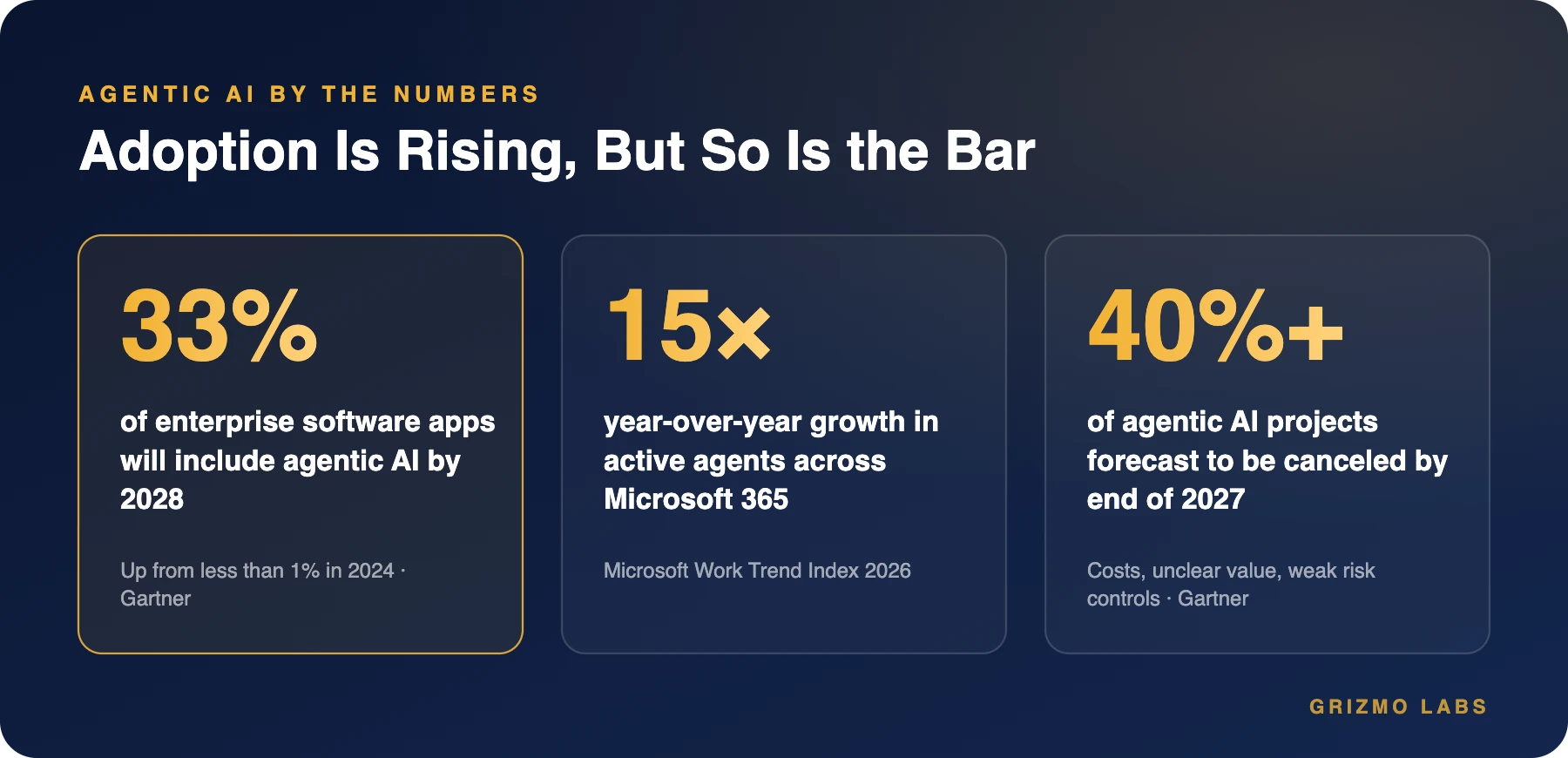
According to a June 2025 forecast from Gartner, 33% of enterprise software applications will include agentic AI by 2028, compared with less than 1% in 2024. Microsoft’s 2026 Work Trend Index also reported 15-fold year-over-year growth in active agents across its Microsoft 365 ecosystem.
Taken together, these indicators suggest growing enterprise interest in agent-based workflows. However, adoption should not be confused with proven return on investment. Similarly, an October 2026 analysis from Gartner emphasizes that organizations must increasingly demonstrate control over agent behavior, reliability, and operating costs.
4. Software economics are being reconsidered
Traditional SaaS pricing often depends on users, licenses, features, or consumption. Agentic systems create opportunities for alternative commercial models, including:
- Per completed workflow.
- Per successfully resolved support case.
- Per processed transaction.
- Per verified business outcome.
- Hybrid subscription and usage-based pricing.
Outcome-based pricing is particularly attractive when the result is measurable, repeatable, and attributable to the software. On the other hand, it also introduces complexity: vendors must account for model inference costs, unsuccessful attempts, human review, integrations, and service-level commitments.
The economics of agentic software will depend on the cost of reliably completing work, not merely generating responses.
How Agentic AI Changes Enterprise Software Architecture
Traditional SaaS architecture typically revolves around applications, databases, interfaces, business logic, and APIs. Agentic architectures introduce additional execution and control layers. A simplified enterprise agent system might include:
- Goal and instruction layer: Receives user objectives, constraints, policies, and success criteria.
- Reasoning and planning layer: Uses AI models to interpret context and determine appropriate next steps.
- Orchestration layer: Coordinates workflows, agents, task dependencies, retries, and execution state.
- Tool and integration layer: Connects agents to databases, enterprise applications, APIs, and authorized external services.
- Memory and context layer: Maintains relevant workflow context and retrieves approved information when needed.
- Evaluation and observability layer: Measures task completion, output quality, latency, cost, failures, and policy compliance.
- Governance and security layer: Controls identity, permissions, data access, approvals, audit trails, and escalation.
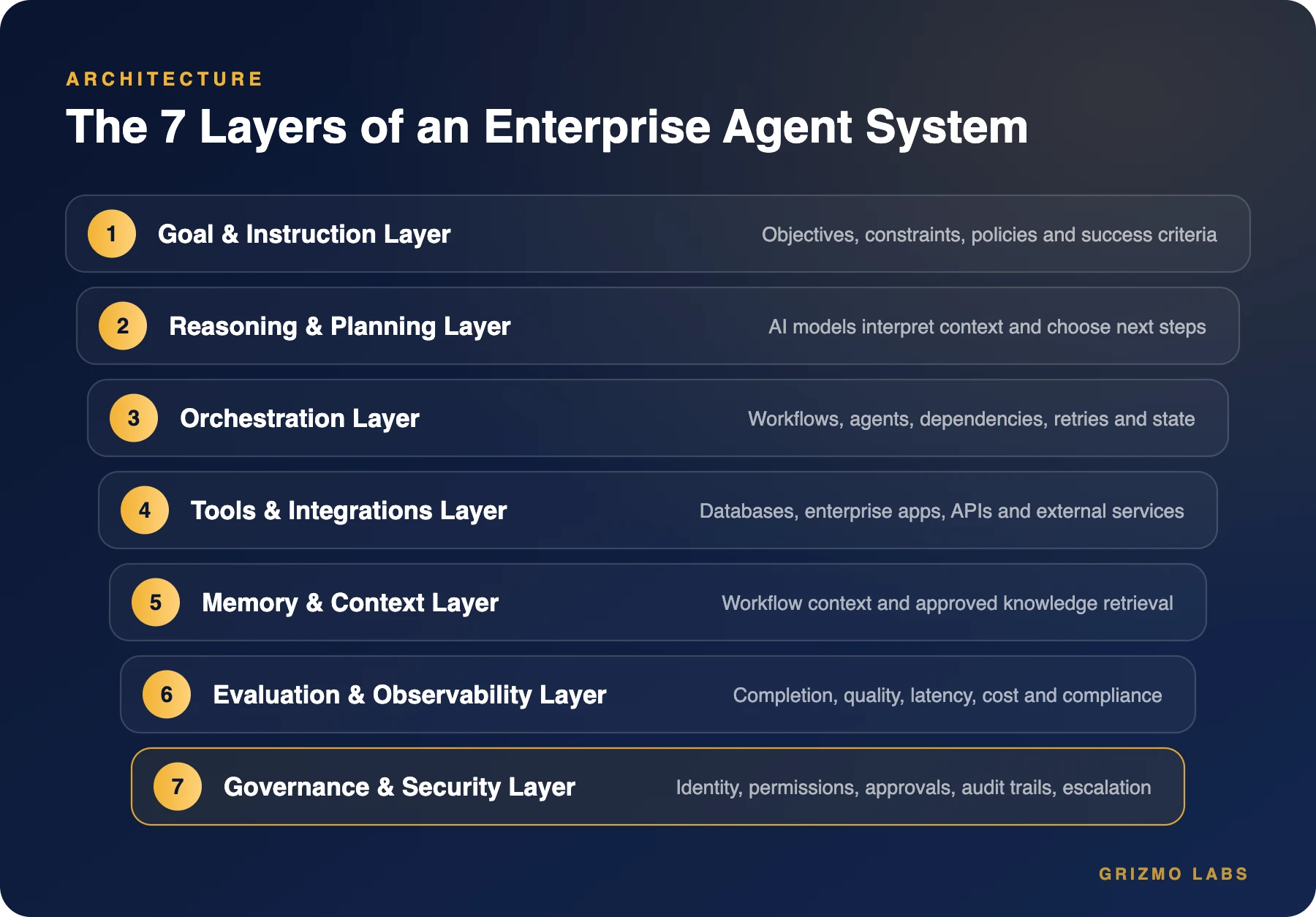
For engineering leaders, these layers create challenges that go well beyond prompt engineering. A compelling demonstration is relatively easy to build. A reliable enterprise agent that performs consistently across thousands of real-world workflows is substantially harder. This is the same shift we explore in why companies are moving from traditional SDLC to agentic SDLC.
Five Industries Where Agentic AI Could Create Significant Value
1. Recruitment and talent acquisition
Recruitment involves research-intensive workflows, coordination, information retrieval, and repeated administrative activities. Agentic AI could support:
- Candidate discovery and talent mapping.
- Resume parsing and structured skill extraction.
- Evidence-based candidate matching.
- Interview scheduling and coordination.
- Recruitment pipeline reporting.
- Candidate communication drafts.
However, hiring decisions require human accountability, privacy safeguards, bias evaluation, and compliance with applicable employment and data-protection laws. The most valuable systems will augment recruiters rather than treat autonomous decision-making as an unquestioned goal. (If you are evaluating partners, see our buyer’s guide to AI recruitment agencies in India.)
2. Customer support
Agentic customer-service systems can retrieve account information, classify issues, suggest resolutions, and perform authorized actions. In addition, organizations may measure success through resolution quality, customer satisfaction, escalation rates, and cost per resolved issue.
3. Financial services
Potential applications include document processing, reconciliation, compliance workflow support, fraud investigation assistance, and operational reporting. Because these workflows can be sensitive, strong audit trails, access controls, and human authorization are essential. Our complete guide to fintech hiring in India covers the engineering talent these systems demand.
4. Software engineering
Engineering agents can assist with code generation, test creation, debugging, documentation, code review, and controlled development workflows. Even so, their impact depends on code quality, test coverage, security, and the ability to work within established engineering standards.
5. Sales and go-to-market operations
Agentic workflows can support prospect research, CRM hygiene, campaign preparation, account intelligence, and sales operations. The opportunity is particularly compelling when agents coordinate several existing tools instead of requiring teams to migrate to entirely new platforms.
Will GaaS Replace SaaS?
Probably not in the simplistic way the question suggests. SaaS platforms remain important systems of record, identity, workflow management, and enterprise data storage. In fact, AI agents need access to these systems to perform meaningful work.
Three developments are plausible:
- AI-enhanced SaaS: Existing applications embed AI assistants and agents.
- Agent-native software: New companies design products around autonomous or semi-autonomous workflow execution.
- Agent orchestration platforms: A coordination layer manages agents operating across multiple enterprise systems.

The competitive landscape could therefore shift toward platforms that combine trusted enterprise data, reliable execution, strong integrations, and measurable outcomes. Rather than announcing the death of SaaS, it is more accurate to describe the emergence of an agentic software economy.
The Biggest Challenges Holding Back GaaS
Despite the promise, production-grade agentic AI remains difficult.
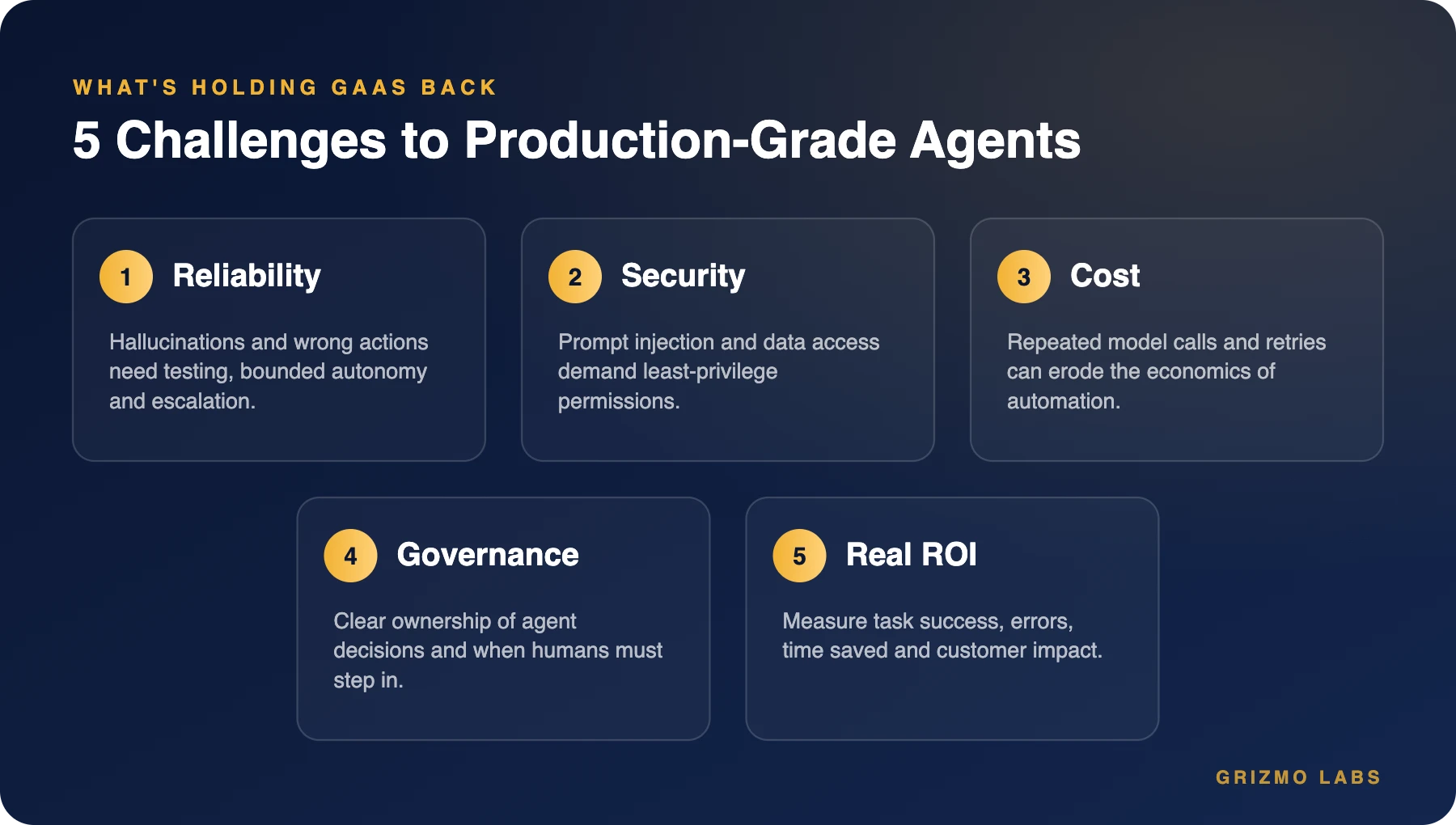
Reliability and hallucinations
AI models can generate incorrect information, misunderstand instructions, or select inappropriate actions. Therefore, enterprise agents need testing, validation, bounded autonomy, and escalation mechanisms.
Security and permissions
Agents connected to business systems can create new attack surfaces, including prompt injection, unauthorized data access, and unintended actions. For this reason, least-privilege permissions, secure integrations, and human approval for high-impact operations are critical.
Cost and scalability
Multi-step workflows can require repeated model calls, external API usage, storage, monitoring, and human intervention. Without cost controls, an apparently inexpensive automation may become commercially unattractive.
Governance and accountability
Organizations must determine who is responsible for agent decisions, how performance is evaluated, and when humans must intervene.
Measuring real ROI
Automating a task is not the same as improving a business outcome. Instead, successful implementations should measure task success, error rates, quality, time saved, operational costs, and customer impact.
Gartner has forecast that more than 40% of agentic AI projects will be canceled by the end of 2027 because of factors including escalating costs, unclear value, and inadequate risk controls.
The lesson is not to avoid agentic AI. It is to build with measurable business value and operational discipline.
The Rise of Agentic AI Engineering Talent
As software moves toward agent-powered execution, engineering hiring requirements are evolving, and the AI skills companies need are changing fast. Consequently, companies increasingly need engineers who can move beyond integrating an LLM API into a product. (For a deeper breakdown of these roles, see our guide to the differences among AI, ML, LLM, and Agentic AI engineers.)
As a result, the emerging skill set combines software engineering fundamentals with AI systems design, production infrastructure, evaluation, and security.
Seven capabilities that matter
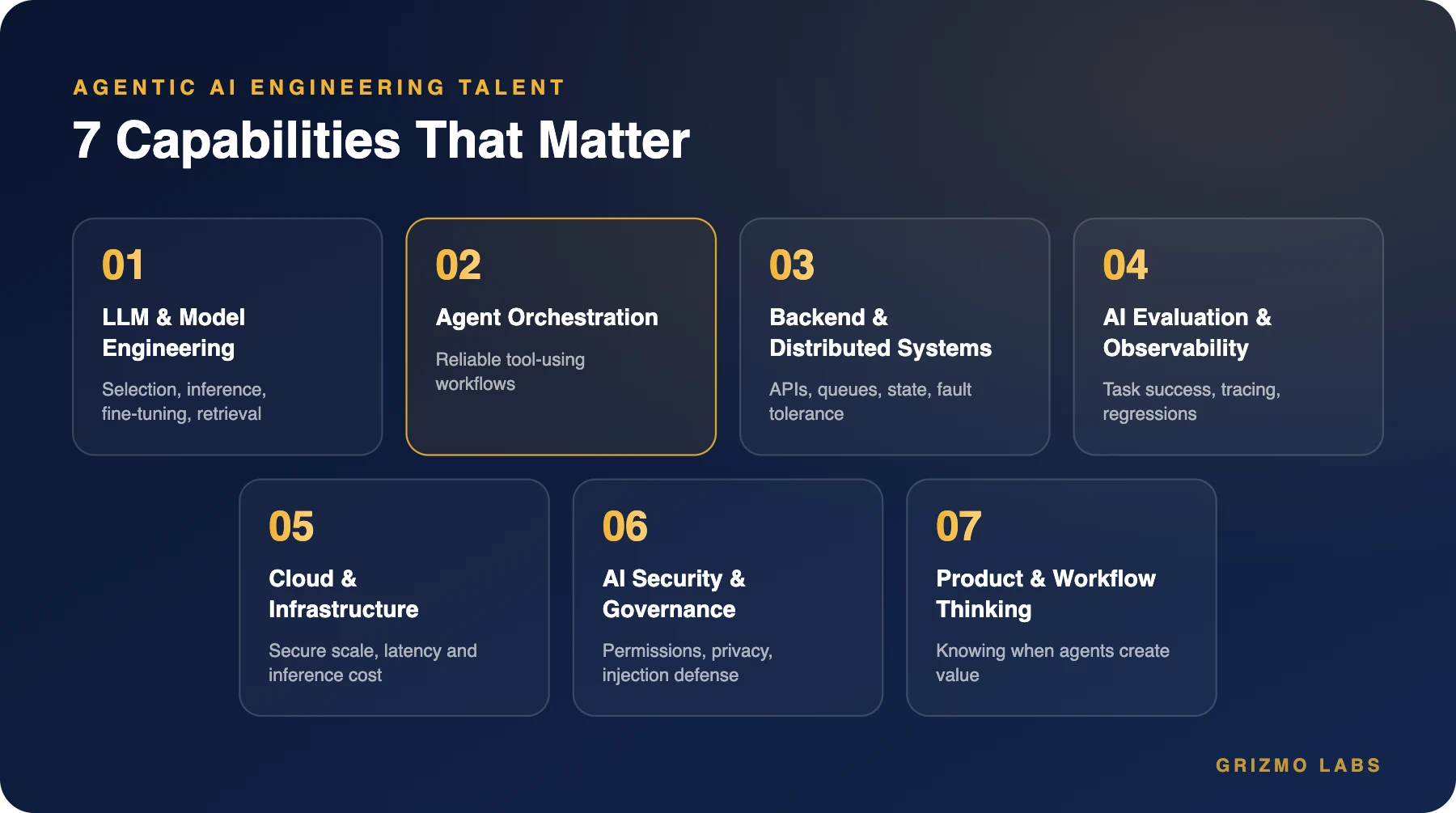
- LLM and model engineering: Understanding model selection, inference behavior, fine-tuning, retrieval, and evaluation.
- Agent orchestration: Building reliable tool-using workflows with frameworks or custom orchestration systems.
- Backend and distributed systems: Designing APIs, asynchronous execution, queues, state management, and fault-tolerant services.
- AI evaluation and observability: Testing agent behavior, measuring task success, tracing failures, and detecting regressions.
- Cloud and infrastructure engineering: Deploying secure, scalable systems while controlling latency and inference costs.
- AI security and governance: Managing identity, permissions, data privacy, prompt-injection defenses, and audit trails.
- Product and workflow thinking: Understanding business processes and determining when agents genuinely create value.
Not every role requires expertise in model pre-training or fine-tuning. A strong applied AI engineer may specialize in reliable orchestration and integrations, while a core LLM engineer focuses on model adaptation, training, and optimization. Both skill sets are important; however, they solve different problems.
For founders building agent-native startups, hiring the right combination of these capabilities may be more valuable than hiring exclusively for familiarity with popular AI frameworks. Our guide to founding engineer roles and responsibilities covers how to structure that first technical team, and our guide to hiring AI talent in India explains where to find it.
What Founders and CTOs Should Do Now
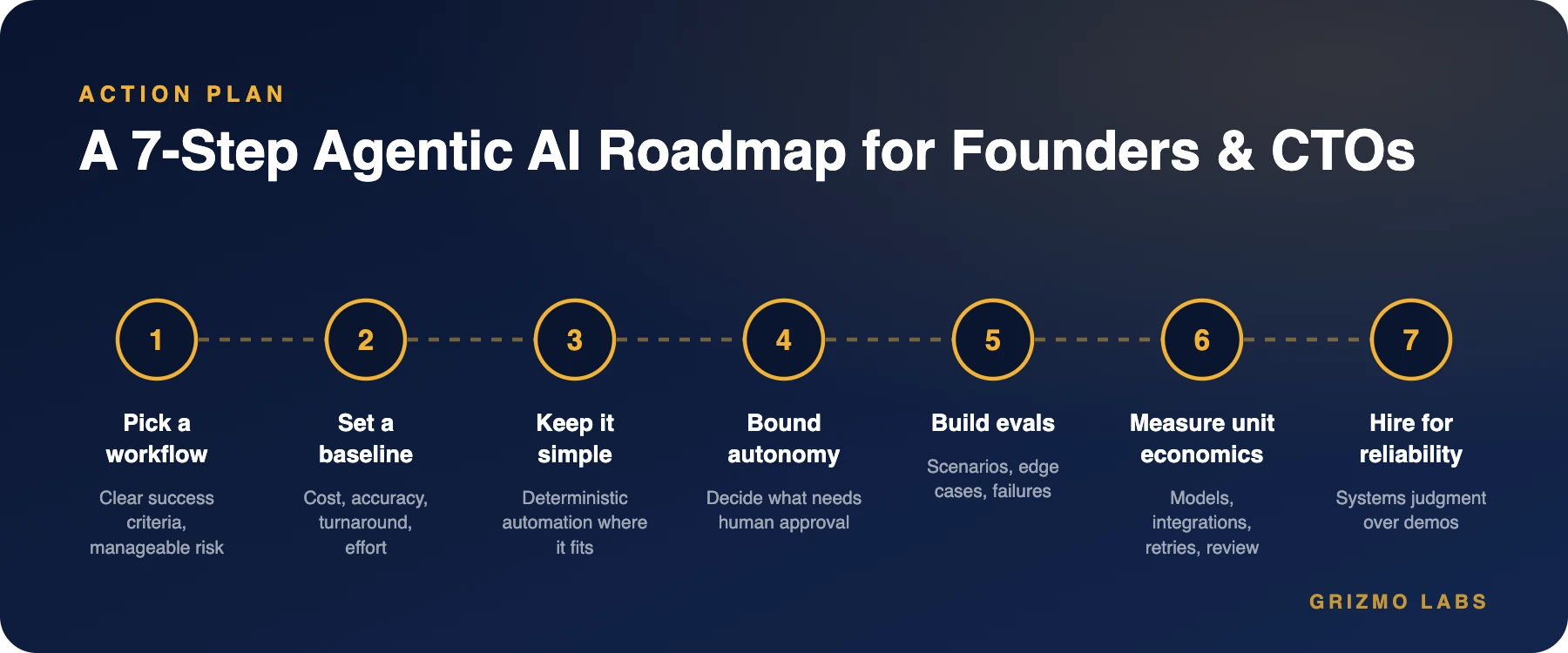
Organizations considering agentic AI should resist the temptation to automate everything immediately. Instead, a more disciplined approach is to:
- Identify a measurable workflow. Choose a process with clear success criteria and manageable risk.
- Establish a baseline. Measure current cost, accuracy, turnaround time, and manual effort.
- Select the simplest effective architecture. Some problems need deterministic automation, not autonomous agents.
- Define autonomy boundaries. Specify which actions require human approval.
- Build an evaluation framework. Test realistic scenarios, edge cases, and failure conditions.
- Measure unit economics. Include model costs, integrations, retries, and human supervision.
- Hire for production reliability. Prioritize engineering judgment and systems expertise over demonstrations alone. A structured technical hiring pipeline makes this repeatable.
The winners in agentic AI are unlikely to be determined solely by which company deploys the most agents. They will be determined by which companies can deliver trusted, economically sustainable outcomes.
The Future of Software Is Not Just Intelligent. It Is Action-Oriented.
The SaaS revolution made software accessible. Generative AI made software more conversational and capable of creating content. Agentic AI introduces the possibility of software that can plan, coordinate, and execute meaningful work.
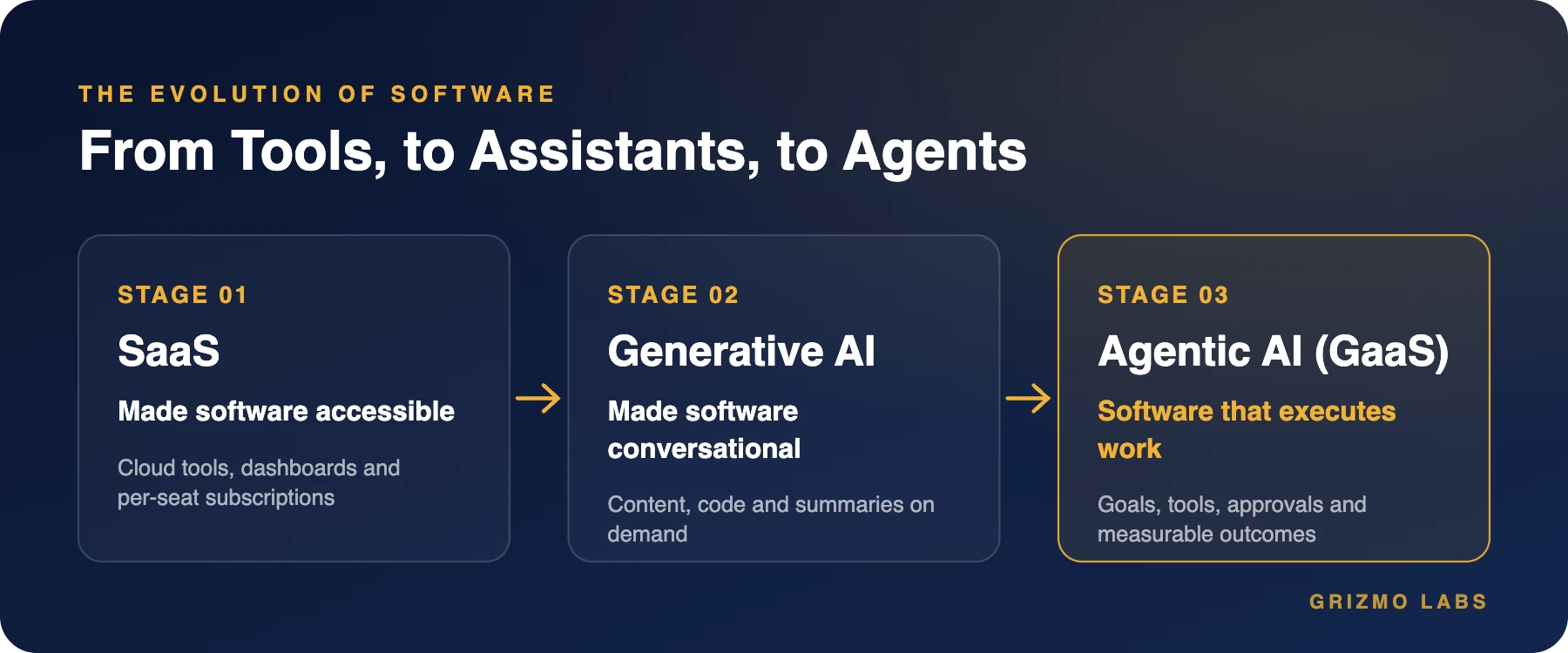
The emerging GaaS model captures this shift toward managed, agent-powered services. But the future will not be defined by autonomy alone. It will be defined by the combination of intelligence, engineering reliability, human oversight, and business value.
The next competitive advantage may not be having more software. It may be having software that can reliably do more of the work.
Building an Agent-Native Company? Start With the Right Engineers.
At Grizmo Labs, we specialize in helping startups and scaling technology companies identify engineering talent for complex, high-impact roles.
Our focus spans Founding Engineers, AI/ML, LLM, and Agentic AI Engineers, Backend and Infrastructure Engineers, and Engineering Leaders and CTO-level talent. Not sure when to bring in technical leadership? Read when is the right time to hire a CTO.
As enterprise software evolves toward agentic architectures, building the right engineering team becomes a critical strategic decision.
Build the team behind your next AI breakthrough.
Frequently Asked Questions
What is GaaS in artificial intelligence?
In this article, GaaS means Agentic AI as a Service: the delivery of AI-agent capabilities through managed services that can execute defined workflows. The acronym is not universally standardized and can refer to other technology categories.
What is the difference between SaaS and GaaS?
SaaS generally provides software tools through cloud subscriptions. Agentic AI as a Service emphasizes the execution of tasks or workflows through AI agents, often using existing SaaS applications as underlying infrastructure.
Will agentic AI replace SaaS?
Agentic AI is more likely to transform and complement SaaS than replace it completely. Enterprise applications, databases, and systems of record will continue to play important roles.
What is an AI-native startup?
An AI-native startup designs its product, technology, or operating model around AI capabilities rather than adding AI as a secondary feature. See how AI talent is transforming startup growth for more.
What skills are required to build agentic AI products?
Important skills include Python or TypeScript, backend engineering, LLM integration, orchestration, API development, evaluation, observability, cloud infrastructure, and security.
Is GaaS suitable for every business workflow?
No. Agentic systems are most useful when flexible reasoning, tool use, or contextual decisions are needed. Deterministic automation is often more economical and reliable for predictable tasks.